Greenland's Power Play: How the EU Critical Raw Materials Deal Forged a 'Sovereignty-Plus' Economic Model
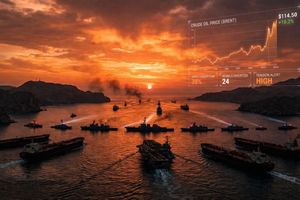
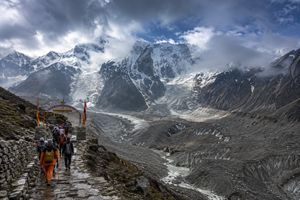
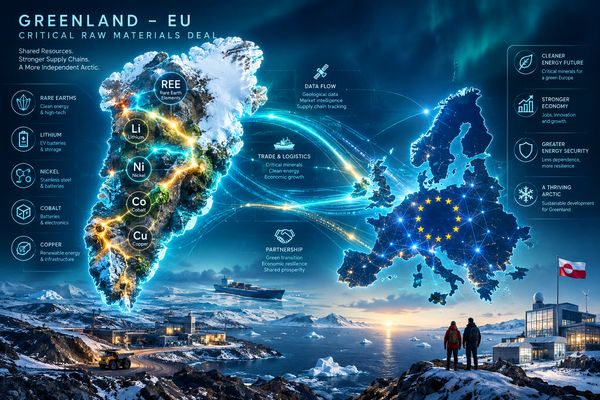 Greenland's strategic pivot: leveraging critical raw materials for a 'Sovereignty-Plus' economic future with the EU.This image is a conceptual representation of Greenland's strategic economic future with the EU and does not depict actual events or infrastructure.
Here’s what’s blowing up in the world of geopolitics and economics: Greenland and the EU are doing the absolute most, and it's creating a whole new vibe for how smaller nations can flex their economic muscle. We're talking about a paradigm shift, fam, where 'Sovereignty-Plus' isn't just a buzzword—it's becoming the actual blueprint. If you thought resource deals were just about digging stuff up and shipping it out, you're about to have your mind blown. This isn't your grandma's extractive model; it’s a full-stack, strategic partnership that’s rewriting the rules.
The technical distinction is important: the €200 million Global Gateway Partnership Package announced on 7 September 2026 isn't a direct payout for mineral access. The official documents instead describe a multi-sector package. Instead, it is a multi-sector package, covering everything from satellite and cable connectivity and hydropower to critical raw materials, better housing, sustainable tourism and support for small businesses [1]. This package is layering on top of the 2023 EU-Greenland strategic partnership on sustainable raw-material value chains, a document that explicitly states it creates no legal obligations or financing commitments [25]. It's a series of strategic moves, not a single, one-off transaction. This intricacy is the key point, demonstrating a more sophisticated approach to resource diplomacy than traditional agreements. 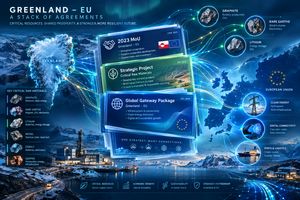 The multi-layered agreements forging the Greenland-EU partnership are building a complex, interconnected economic strategy.This image is a conceptual representation of the multi-layered agreements between Greenland and the EU and does not depict actual documents or infrastructure.
What Exactly Did the EU and Greenland Agree To? Let's Break It Down.
Okay, so, let's get one thing straight because the internet can get super sloppy with this kind of intel. There isn't just one singular "Greenland-EU raw materials deal" worth €200 million. That's a total misconception, a red herring designed to throw you off. What we're actually witnessing is a multi-layered, multi-year saga of agreements and financing mechanisms that have been stacking up like a boss level in a game.
First up, Greenland already had a thing going with the EU as an Overseas Country and Territory. Then came the strategic shift: on 30 November 2023, the EU and Greenland signed a Memorandum of Understanding to establish a strategic partnership focused on sustainable raw-material value chains. Fast forward to 7 September 2026, and the partnership had expanded into a €200 million Global Gateway Partnership Package, with cooperation covering areas including critical raw materials, connectivity, and sustainable energy [2][3][5]. See? It's a whole strategic stack, not a single transaction. The 2023 MoU, for all its strategic importance, was literally just a framework, explicitly stating it "does not create any rights or obligations under international or domestic law" and no financing commitment [25]. So, anyone calling that a mining contract? Hard pass. European Commission President Ursula von der Leyen said it best: "Greenland can count on the EU" [1].
The 2026 package, however, is a different beast entirely. It's Global Gateway money, baby, earmarked for everything from digital connectivity and sustainable energy to critical raw materials, tourism, and even housing [1]. The raw-materials component includes support for work around projects and value chains, with Amitsoq cited by the Commission as a concrete example of a potential integrated Greenland–EU value chain [6]. The key distinction is that €200 million isn't just a direct cheque for Amitsoq. It's a distributed investment across several sectors, some direct, some preparatory, some about future financing. This is where the 'Sovereignty-Plus' concept becomes analytically useful. The analytical point is not a direct swap of cash for ore. Rather, the documents connect strategic resources with infrastructure, investment, skills, energy, digital connectivity and value-chain development. The 2023 MoU covers cooperation across exploration, extraction, processing and refining, alongside investment, infrastructure, skills, research and innovation [2].
Demystify the Deal Stages:
When you hear those viral headlines about a "€200 million Greenland minerals deal," be a careful analyst and separate the 2023 raw-materials partnership from the 2025 Strategic Project designation and the 2026 Global Gateway package. They're related, sure, but they're distinct legal and financial instruments – knowing the difference is your superpower.
Why Does Greenland Have So Much Negotiating Leverage?
Greenland's got its combination of geography, resources and domestic regulatory authority, and it all starts with something brutally simple: geology plus jurisdiction. This place is massive—Statistics Greenland drops the info that its total area is about 2.2 million square kilometres, with like 81% under ice [7]. Yet, the population on 1 January 2025 was only 56,542 [7]. Towns? All coast. Roads connecting them? Nah, we don't do that here; it's all about sea and air transport [7].
This creates an economic equation that's wild. You can have critical minerals chilling under the ice, but without the people, infrastructure, or industrial base to get them out at scale, they're just, well, rocks. The real challenge isn't finding the minerals; it's turning that rock into something economically viable. Naaja H. Nathanielsen, Greenland's Minister for Business and Minerals, gets it: "Mining projects contribute to the Government’s goal of an independent economy" [8]. That quote right there? That's the heart of the Sovereignty-Plus model. Greenland's minerals aren't just geological curiosities; they're integral to a bigger national ambition: building a more diversified economy. For context, fisheries accounted for 16.7% of Greenland's GDP and 96.1% of total export value in 2021 [26]. So, yeah, minerals are a big deal, politically, even before a single mine is fully operational.
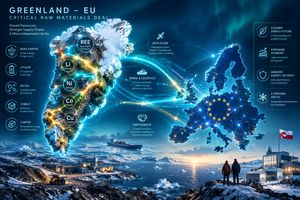
If you're too reliant on one export, a new successful pillar can be a game-changer, reducing that concentration risk. But let's be real, "potentially" is doing heavy lifting here. Mineral development is a marathon, not a sprint: years of capital, environmental hurdles, social approvals, and then—maybe—production. Still, Greenland's resource position is uniquely aligned with European industrial policy. The European Commission states that 25 of the 34 critical raw materials it identifies can be found in Greenland and are strategically important to European industry and the green transition [3]. Now, that doesn't mean Greenland's suddenly replacing global suppliers, but it does mean this small jurisdiction has strategic relevance to a massive industrial market. And that, my friends, is what changes the negotiation game. A resource nobody needs? Zero leverage. A resource an industrial bloc is scrambling to diversify? Major leverage. Greenland also has a domestic mineral-licensing framework, while the EU relationship adds channels for cooperation, investment and institutional support [2][10]. That's the real power dynamic behind 'Sovereignty-Plus': not sovereignty in isolation, but sovereignty amplified by strategic interdependence. 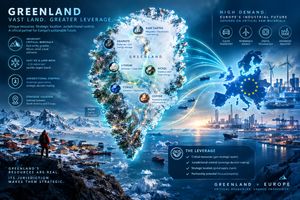 Greenland's vast geology and self-governing jurisdiction give it unique leverage in critical raw materials negotiations.This image is a conceptual representation of Greenland's strategic importance and does not depict actual geological formations or market dynamics.
What Headlines Can Miss: Strategic Value Isn’t Just About Volume
Here’s an edge case that’s often overlooked in the sensational headlines: the EU doesn’t need Greenland to become a global mining titan for this relationship to be a win. Even a smaller, strategically placed project can make a huge impact. Think about it: if it helps diversify a specific European supply chain, builds downstream expertise, locks in European offtake deals, or simply offers a viable alternative to highly concentrated supply, it’s a massive win. The EU’s Critical Raw Materials Act is all about reducing dependence on single third countries and building diversified supply chains [11]. This means strategic value isn't always about the sheer volume of minerals. A relatively modest project can hold immense geopolitical importance if it shaves off vulnerability in a critical segment. That's the real strategic sauce.
Assess True Bargaining Power:
To truly understand Greenland’s leverage, look beyond the size of a mineral deposit. The real metric is the powerful combo of resource relevance, legal control, project readiness, robust infrastructure, and seamless downstream market access. That's the ultimate power flex.
How Does Amitsoq Graphite Fit Into the Story?
Alright, let’s get down to brass tacks: Amitsoq. This graphite project, chilling in southern Greenland's Nanortalik region, is where the narrative goes from theoretical to concrete. The Government of Greenland granted a 30-year exploitation licence for Greenland Graphite A/S on 8 December 2025 [12]. But hold up—that licence didn't just give them a golden ticket to start digging. This distinction is crucial, a real mic drop moment. The licence grants exclusive rights within a defined area, but there are still major hurdles to clear before exploitation can actually kick off [12]. Stefan Bernstein, CEO of Greenland Graphite A/S, rightly called it an "important milestone" on the path to making graphite production a reality again [12].
And yeah, this project has history! The Amitsoq site actually housed a graphite mine way back from 1914 to 1922 [12]. So, this isn't some brand-new discovery; it's a modern glow-up of a historically known graphite district. GreenRoc, the company, is reporting a combined Measured, Indicated, and Inferred JORC Mineral Resource of 23.05 million tonnes at an average grade of 20.41% graphitic carbon, which means 4.71 million tonnes of contained graphite [13]. Keep in mind, these are company-reported figures under the JORC framework, not government estimates. While mining headlines love to throw around "world-class deposit"—and you know they do—investors need to ask: what's actually proven, and what's still in the realm of potential? A mineral resource isn't the same as economically recoverable reserves, and a project can have massive resources and still fall flat due to a million other factors like metallurgy, infrastructure, or commodity prices.
Amitsoq’s journey is a case study in itself. GreenRoc has been advancing purification and downstream processing work at Amitsoq, including testwork aimed at upgrading the graphite into high-quality spherical graphite and ultimately active anode material for batteries [13]. But the real plot twist? On 4 June 2025, the European Commission selected the Norgraph A/S and Greenland Graphite A/S project as a Strategic Project under the Critical Raw Materials Act [14]. The nuance is that the Strategic Project is not simply an Amitsoq-only designation: the Commission’s formal decision identifies an integrated extraction and processing project involving Norgraph A/S in Norway and Greenland Graphite A/S in Greenland, promoted by GreenRoc, with the aim of contributing to battery-grade graphite supply [15]. This isn't just Greenland selling ore; it's Greenland extracting, integrating processing, and feeding into a European industrial value chain. That structure has the potential for way more economic value than just exporting raw minerals.
Key Qualification: Strategic Project Status Does Not Equal a Funded Mine
Listen up, because this is a major edge case that gets blurred constantly: being designated an EU Strategic Project is powerful, but it’s NOT the same as getting a cheque for a fully funded mine. Under the CRMA, selected Strategic Projects can benefit from support for access to finance and shorter permitting timeframes, while projects must demonstrate technical feasibility, expected production volumes, and sustainable implementation [11][16]. But it doesn't magically manifest a producing mine. Amitsoq still has to navigate environmental and social procedures, public consultations, Impact Benefit Agreements, and get mine and closure plans approved [12]. Under the current licence conditions, mining activities must commence by 31 December 2030 unless otherwise approved; that date is a licence condition, not a guarantee that production will begin [12]. So, when someone screams, "Greenland just got an EU-backed graphite mine!" just calmly hit pause. The real, verified tea is that Greenland licensed it, the EU designated it as Strategic, the EU is supporting the broader partnership, and multiple development and approval steps are still ahead. That is the documented position.
Distinguish Development from Production:
For any serious analysis, treat Amitsoq as a strategically designated development project, not an operating mine. Keep your eyes peeled for EIA/SIA approvals, Impact Benefit Agreements, mine-plan sign-offs, actual financing, construction, and, finally, production—those are entirely separate milestones.
Is the EU Really Just Paying Greenland for Its Minerals?
Let's absolutely obliterate this misconception right now: the official documents do not describe that the €200 million package is some kind of direct payment for mineral access. None. Nada. That is not how the official documents describe the package. The 2023 MoU, remember, explicitly says no legal rights, no obligations, and no financing commitment [25]. And the 2026 package? It’s multi-sectoral by design [6]. European Commissioner Dan Jørgensen framed the relationship in terms of "security, our independence and our competitiveness" [23]. This isn't a simple transaction; it's a strategic alliance.
The language from Brussels itself frames this as a wide-ranging strategic partnership, not a mineral purchase. The new package is a buffet of support: satellite connectivity, cable infrastructure, hydropower, institutional capacity building, tourism, and housing—with critical raw materials just one item on that expansive menu [6]. The raw materials part focuses on technical analyses and investor partnerships, aiming to build more integrated value chains [6]. So, throw out the simplistic narrative of "EU gives Greenland €200 million; Greenland gives EU graphite." The real story is infinitely more nuanced: "The EU is expanding a multi-sector relationship with Greenland where strategic raw materials are one component of a much larger economic and geopolitical partnership." This distinction doesn't sideline the minerals; it actually makes the entire arrangement even more fascinating, because infrastructure investments can totally transform the economics of mineral development without being a direct mine subsidy.
Think about it: mining and processing guzzle energy, and Greenland's geography makes infrastructure a beast. The EU and Greenland are exploring energy infrastructure support, including upgrades for the Buksefjord hydropower plant and modernizing energy supply in remote settlements [6]. Communications? The 2026 package includes satellite capacity expansion. Institutional capacity? There's even support for a program-management unit within Greenland's government [6]. Connect those dots, and you see the bigger picture. A mine isn't a standalone entity; it needs power, communication, transport, skilled workers, financing, permits, environmental monitoring, buyers, and a robust institutional system to manage it all. The 2023 raw-materials MoU acknowledges this entire ecosystem, calling for cooperation across infrastructure, skills, investment, and research alongside the extraction and processing [2]. That's the real economic architecture at play.
Key Qualification: Infrastructure Can Matter as Much as Direct Project Finance
An important distinction is: imagine two places with identical mineral deposits. Place A has trash electricity, limited connectivity, insane logistics costs, and weak access to cash. Place B has reliable renewable energy, modern comms, stronger institutions, access to European finance, and a direct pipeline into European industrial supply chains. Same geology, totally different projects. This is why the infrastructure component may matter as much as, or in some cases more than, direct project finance. The EU’s Global Gateway strategy is literally built on infrastructure and investment partnerships across digital, climate, energy, transport, health, and education [17]. The 2023 MoU explicitly links this infrastructure logic directly to raw-material projects [2]. That is the strategic logic of the arrangement.
Look Beyond the Cash for Clues:
Don't just measure the Greenland-EU arrangement by direct mining finance. Track the infrastructure, energy, connectivity, technical assistance, and market-access mechanisms. These can influence the cost, feasibility and resilience of strategic industries, making them important indicators of long-term impact.
What Does 'Sovereignty-Plus' Actually Mean?
Alright, let's unpack 'Sovereignty-Plus.' Again, let me be crystal clear: this is my analytical label, not some official doctrine. But the idea? It's pure fire. Traditional resource sovereignty asks a basic question: "Who owns or controls the resource?" Sovereignty-Plus, however, asks the juicier, second-level question: "How can control over a strategically valuable resource actually boost the jurisdiction's bargaining power across its entire economy?" That second question is where the magic happens, where everything shifts.
Jozef Síkela, European Commissioner for International Partnerships, said that the EU offer is to link raw-materials cooperation with "skills, quality jobs, access to clean energy and essential services" [24]. That's the 'Plus' right there. The classic extractive model is super linear, super basic: Resource → foreign capital → extraction → export. But Sovereignty-Plus? That’s networked, it’s intricate, it’s a whole vibe: Resource → strategic relevance → bargaining power → infrastructure → skills → investment → value-chain integration → greater economic resilience. This isn't just semantics; it's the actual architecture you see in Greenland’s agreements. The 2023 MoU goes beyond extraction: it calls for cooperation on sustainable exploration, extraction, processing and refining, as well as investment, infrastructure, skills, research and innovation [2]. That’s a full-on value-chain strategy.
And here’s the kicker: local value creation. The EU partnership document explicitly states that Greenland's mineral sector should contribute to sustainable and inclusive economic growth with local and domestic value creation [2]. Greenland’s own mineral-resource framework is designed to consider Greenlandic workers, businesses, and local processing [18]. Does that guarantee every stage of production happens locally? No, it doesn't. But it means the regulatory framework is literally built to support domestic participation. That’s a game-changer.
The Four Layers of Sovereignty-Plus: A Masterclass.
I break this model down into four distinct, powerful layers. Think of it as your cheat sheet for understanding the framework:
1. Resource Sovereignty:
This is where the jurisdiction keeps the ultimate say over licensing and the conditions for extraction. In Greenland's case, their mineral licensing system is run by their own institutions, under their own laws [10][12]. They own the gate.
2. Infrastructure Bargaining:
Here, the jurisdiction leverages the strategic importance of resource development to pull in investment for power, water, comms, and transport. The EU-Greenland MoU specifically calls out infrastructure funding as a key area for cooperation [2]. It's about building foundational strength.
3. Value-Chain Bargaining:
Instead of just shipping out raw ore, the jurisdiction aims to participate in the juicier parts of the supply chain—processing, manufacturing, services, research. The EU's Strategic Project framework covers strategic raw-material projects across activities including extraction, processing, and recycling [11]. It’s about getting more bang for your buck.
4. Institutional Bargaining:
This is about building expertise, administrative capacity, environmental standards, and financial savvy that sticks around long after a single mine project. The 2026 EU package supporting a program-management unit within Greenland’s government is a perfect example of this [6]. It’s about building long-term capability.
Stack all four of these, and you get something way more epic than just "selling minerals to Europe." You're literally converting geological scarcity into lasting economic capability. That's the core idea, the whole idea of 'Sovereignty-Plus.'
Understand the 'Plus' Layers:
To grasp the true power of Sovereignty-Plus, analyze deals through these four lenses: resource sovereignty, infrastructure bargaining, value-chain bargaining, and institutional bargaining. This holistic approach reveals how jurisdictions can convert raw potential into robust, long-term economic strength.
Can Greenland Actually Turn Minerals Into Economic Resilience?
Potentially—but this is where we gotta keep it real, and the evidence demands serious discipline. Greenland’s economy remains heavily concentrated around fisheries, while the mineral sector has historically represented a much smaller share of economic activity [7][9]. A 2025 assessment of the Arctic economy showed mining and quarrying making up just 0.7% of gross regional product from 2019–2021, despite all the global interest [9]. That gap? It’s enormous, and it tells us something critical: geological potential is NOT economic diversification. A mineral deposit only becomes an economic sector after years of exploration, feasibility studies, permits, financing, construction, production, logistics, and market integration.
Stefan Bernstein, CEO of Greenland Graphite A/S, knows the vibe: "The extraction from Amitsoq must benefit Greenland—particularly the neighbours in South Greenland" [12]. That local-benefit question is not just fluff; it's integral. Greenland's licensing process includes Social Impact Assessments (SIAs), public consultations, and Impact Benefit Agreements (IBAs) [18][19]. The SIA framework addresses the social effects of proposed projects, including their implications for Greenlandic labour, businesses and local conditions [18]. The IBA provides a framework for addressing the impacts and benefits associated with a mineral project, including matters related to local employment, education and training, business opportunities, and other benefits for Greenland and its communities [19]. This is a crucial institutional feature of the Sovereignty-Plus model. A resource jurisdiction isn't just saying, "You can mine here." It's also negotiating, "How does this project interact with our labor market, businesses, communities, and public institutions?"
But let’s be real, "local value creation" can easily become just another slogan. The real test is measurable: how many Greenlandic workers are actually employed? How much procurement goes to Greenlandic firms? What processing really happens locally? What infrastructure benefits communities long-term? What fiscal revenues are generated? What environmental liabilities are left behind after closure? And what skills remain after the mine is gone? What happens if graphite prices crash? Those are the tough questions that determine if Sovereignty-Plus is the real deal or just good branding.
Key Qualification: A Mine Can Increase Dependence, Not Reduce It
This sounds totally counter-intuitive, right? But it's one of the most important lessons in resource economics. A jurisdiction can diversify its exports while simultaneously becoming more dependent on one new commodity. Think about it: if fisheries are still dominant, and then one giant mineral project becomes the second pillar, yeah, that's diversification. But if the government’s revenue, employment, infrastructure, and external financing all become super tied to that single mine, you've just swapped one concentration risk for another. It's a vibe check gone wrong. The cure isn't just "more mining"; the stronger model is building multiple, robust economic capabilities. That's why the breadth of the 2026 EU package is so crucial: raw materials are being pursued alongside tourism, housing, digital infrastructure, energy, education, and institutional capacity [6]. This wider approach is the genuine path to resilience.
Demand Measurable Economic Capabilities:
Judge economic resilience not by a simple increase in mineral exports, but by whether mineral development actively creates multiple durable capabilities. The ultimate win is a diversified economy that remains strong even if one commodity project underperforms or faces market volatility.
Why Is the EU So Interested in Greenland's Minerals?
Okay, let's spill the tea on why the EU is so deeply invested in Greenland. It's simple, really: Europe has a massive supply-chain problem. The EU’s Critical Raw Materials Act identifies strategic raw materials as those absolutely essential for critical tech—think green transition, digitalization, defense, aerospace [11]. The Act set some pretty aggressive 2030 benchmarks: at least 10% of EU annual consumption from domestic extraction, 40% from processing, and 25% from recycling. And there's another big one: no more than 65% of the EU’s annual consumption of a strategic raw material should come from a single third country [11]. Those targets? They scream "diversification," not "autarky." Jozef Síkela, European Commissioner for International Partnerships, put it perfectly: "Securing reliable supplies of critical raw materials is a strategic priority for Europe’s resilience and competitiveness" [24]. This isn’t about becoming self-sufficient in every single mineral; it’s about building a supply system that isn’t vulnerable to concentrated external dependencies.
Greenland, with its resource potential and existing political and economic ties to Europe, slots perfectly into this strategy. The EU's 2023 MoU explicitly frames the partnership as a way to support European strategic autonomy while developing Greenland's mineral sector as a future supplier [2]. It’s candid, it’s transparent: both sides have something the other desperately needs. Greenland has geological potential; Europe has industrial demand, expertise, capital, and a huge market. That's the basic exchange. But there's a deeper layer, a real geopolitical flex: the Joint Declaration recognises Greenland’s growing strategic importance, while the EU-Greenland partnership now spans security, connectivity, clean energy, critical raw materials, infrastructure, resilience, and climate-related cooperation [1][6]. This isn't saying every Greenland mining project is a security project, but it acknowledges the shifting political context that elevates the value of this long-standing relationship.
The EU's Strategy Isn't Just Greenland: A Global Flex.
Here’s another edge case that helps paint the full picture: the EU isn't putting all its eggs in the Greenlandic basket. They've forged raw-material partnerships with a whole crew of countries, including Canada, Kazakhstan, Namibia, Chile, Australia, Norway, Rwanda, Serbia, and the US, just to name a few [20]. This is super important because it tells us the EU isn't inventing a Greenland-only resource strategy. Greenland is a crucial piece of a much wider, global diversification puzzle. The 2025 Strategic Project list reinforces this, with projects selected across multiple countries and regions, covering graphite, nickel, cobalt, rare earths, tungsten, and more [15][16]. So, while Greenland’s role is vital, it’s part of a much bigger, orchestrated global play.
Key Qualification: Europe May Value Diversification More Than Sheer Volume.
This is a subtle but powerful edge case: a project doesn’t need to replace an entire national supply chain to be strategically significant. If it provides a credible alternative source, strengthens processing capabilities, establishes an offtake relationship, or simply reduces exposure to a single, dominant supplier, it has immense strategic value. The CRMA emphasizes diversifying EU imports and reducing strategic dependencies by building strong, resilient and sustainable raw-material value chains [11]. For Greenland, this is fantastic news. It means a project doesn't have to become "the next China" in graphite production to matter to Europe. It just needs to be credible, reliable, and contribute to that crucial diversification.
Rethink Project Value:
When analyzing a strategic mineral project, don’t just ask "How much can it produce?" Instead, ask "Which dependency does it diversify, which part of the value chain does it strengthen, and how difficult would it be to replace?" These questions unlock its true strategic worth.
Does Greenland's Model Protect It From Resource Dependence?
Okay, real talk: 'Sovereignty-Plus' isn't a magic shield against becoming another resource-dependent economy. And this is where the analytical label needs a clear qualification. Having strategic resources can absolutely boost bargaining power, but it can also attract powerful external players all vying for influence. Just because a valuable deposit exists doesn't automatically mean the jurisdiction captures that value. The make-or-break question is always institutional design.
Greenland's framework has built-in mechanisms to keep the government and affected communities in the loop. The Social Impact Assessment process demands public consultation, from drafting terms of reference to reviewing assessment reports [18]. The exploitation-licensing framework includes an Impact Benefit Agreement (IBA) as part of the process, addressing the impacts and benefits associated with a mineral project [19]. The EU-Greenland partnership framework even states that the process "must be in close dialogue with the Greenlandic society" [2]. This isn't a guarantee of perfect outcomes, but it's a governance mechanism, and governance mechanisms are everything because mining projects are inherently asymmetric in their risks.
A foreign investor might be able to bail on a failed project, but a community? They can't just walk away from environmental impacts. A company can diversify across countries; a small jurisdiction might only have a handful of major projects. A huge industrial buyer can switch suppliers; a remote mining region might not have alternative employers. That's why IBAs, environmental assessments, and local procurement rules aren't just bureaucratic hurdles; they're vital pieces of the bargaining architecture.
The Hidden Asset: Institutional Capacity — It's Not Boring!
The 2026 EU package includes support for establishing a Programme Management Unit to strengthen Greenlandic institutional capacity [6]. I know, I know—sounds boring, right? Wrong! Institutional capacity is one of the least glamorous but most critically important parts of economic sovereignty. If a government can't properly evaluate mining contracts, monitor environmental obligations, manage infrastructure projects, negotiate financing, or handle procurement, then formal sovereignty exists only on paper, while practical bargaining power remains weak. This is where 'Sovereignty-Plus' truly gets its "plus." The goal isn't just "We control the licence"; it's "We have the expertise and institutions to use that control effectively." That's a radically different, and much more powerful, proposition.
Fortify Your Governance Game:
For resource-rich jurisdictions, focus intensely on institutional design. Implement robust Social Impact Assessments, public consultations, and Impact Benefit Agreements. Prioritize building the internal capacity to evaluate contracts, monitor compliance, and manage complex projects effectively. Strong governance transforms potential into captured value.
Could Other Resource-Rich Small Jurisdictions Copy Greenland?
Could other small, resource-rich jurisdictions pull a Greenland and adopt this 'Sovereignty-Plus' model? Absolutely—but they can't copy Greenland's geology. They can, however, copy the logic. That's a key distinction. A small jurisdiction doesn’t need graphite; it needs something a larger market considers strategically vital. That could be anything: minerals, energy, specialized industrial inputs, fisheries, strategic ports, renewable energy potential, digital infrastructure—any scarce economic asset. But this model only hits if five conditions perfectly align.
1. The Jurisdiction Must Retain Meaningful Legal Control:
If the resource is already under external control before negotiations even start, your bargaining power is toast. Greenland’s mineral licensing framework requires projects seeking an exploitation licence to go through defined assessment, consultation, and approval steps before exploitation can proceed [10][12]. That's non-negotiable.
2. The Resource Must Matter to a Larger Market:
Strategic scarcity creates leverage; ordinary abundance does nothing. Greenland’s EU relationship is strengthened because Europe is actively trying to diversify critical raw-material supplies [11][20]. Know what you have that others desperately need.
3. Infrastructure Must Become Part of the Bargain:
This is probably the biggest lesson. Don't just haggle over royalties. Negotiate hard for power grids, ports, telecommunications, water systems, roads, training programs, research facilities, and local suppliers. The 2023 EU-Greenland MoU explicitly bakes infrastructure and skills into the raw-material partnership [2].
4. Local Value Creation Must Be Measurable:
"Local benefits" need to translate into concrete contracts, real jobs, tangible skills, actual processing, taxes, infrastructure that serves communities, and durable local businesses. Greenland's SIA and IBA structures formalize some of these issues [18][19]. If you can't measure it, it probably didn't happen.
5. Multiple Partners Reduce Leverage Risk:
Ideally, a jurisdiction should avoid becoming overly reliant on a single external power. The EU’s own raw-material strategy is all about diversifying across many partners [11][20]. The same principle works in reverse: a small jurisdiction can strategically diversify its external relationships. That is the central strategic logic of the model. You don’t have to pick between "foreign investment" and "sovereignty." The smarter move is "foreign investment on terms that strengthen sovereignty."
Model Your Strategic Framework:
If you're a resource-rich jurisdiction, assess your bargaining power against these five conditions. Prioritize retaining legal control, identifying strategic resources for major markets, integrating infrastructure into deals, ensuring measurable local value, and diversifying your external partnerships. This framework is your roadmap to 'Sovereignty-Plus'.
What Are the Biggest Misconceptions About the Greenland-EU Deal?
Let's absolutely decimate the most tempting, viral misconceptions about this entire deal. These are the narratives that get shared endlessly but are just… wrong.
Misconception #1: "The EU paid Greenland €200 million for its minerals."
Not established by the evidence. The €200 million package announced on 7 September 2026 is a broad Global Gateway partnership covering multiple sectors, not a direct payment for minerals. The raw-materials component is focused on technical analyses and investor partnerships [1][6]. Hard facts only.
Misconception #2: "Amitsoq is already an operating mine."
No. Greenland granted an exploitation licence in December 2025, but the government explicitly states that additional approvals are necessary before extraction can begin [12]. It's a project in development, not a producing mine.
Misconception #3: "The EU owns Amitsoq."
Also no. The EU designated the integrated Norgraph A/S and Greenland Graphite A/S project as a Strategic Project under the CRMA [15]. This designation is about facilitating strategic projects and supply security, not ownership of the deposit itself.
Misconception #4: "The 2023 raw-materials agreement legally guarantees financing."
Nope. The MoU explicitly says it creates no legal rights or obligations under domestic or international law and contains no financing commitment from either side [25]. It was a framework, a handshake of intent.
Misconception #5: "Greenland's 25 critical raw materials mean it can supply Europe with all 25."
Absolutely not. The Commission stated 25 of the 34 EU-identified critical raw materials can be found in Greenland [3]. That's about geological potential, not commercially exploitable quantities or economic viability for all of them. Presence doesn't equal production.
Misconception #6: "Strategic Project designation guarantees the mine will be built."
No. The designation is intended to strengthen the EU’s security of supply of strategic raw materials, while Strategic Projects must meet criteria including technical feasibility, expected production capacity, and sustainable implementation [11][16]. It's a boost, not a certainty.
Misconception #7: "The €530 million for 2028–2034 is already secured."
Incorrect. The European Commission has proposed €530 million for Greenland under the next 2028–2034 framework [4]. This is a budget proposal, not a disbursed allocation. Big difference.
Misconception #8: "Greenland is simply becoming a European mining colony."
That's an interpretation, not a verified fact. The documented relationship includes Greenlandic licensing authority, public consultation, social and environmental assessments, Impact Benefit Agreements, and local-value provisions [12][18][19]. Whether those mechanisms achieve equitable outcomes is something that has to be evaluated project by project. Avoid simplistic, colonial narratives where complexity reigns.
Verify the Stage of Development:
Always separate announcements, designations, licenses, financing, and actual production. These are five distinct phases in a project's lifecycle, and conflating them leads to major misunderstandings and missed opportunities for informed analysis.
What Happens Next — And What Should We Watch?
This is where the story leaves the press releases and enters the messy, complex, and utterly fascinating real economy. The first test is implementation. The €200 million Global Gateway Partnership Package is to be invested in and with Greenland in 2026 and 2027, and the Joint Declaration broadens cooperation across a dizzying array of sectors: infrastructure, raw materials, clean energy, connectivity, tourism, housing, research, resilience, and security [1][6]. It's a lot, and it's happening fast.
The second, and equally brutal, test is project financing. A Strategic Project can look amazing on paper, yet still be a nightmare to finance in practice. The EU is using its Strategic Projects framework to strengthen strategic raw-material supply, increase capacity to extract, process and recycle critical materials, and diversify supplies from third countries [16][21]. Jozef Síkela got the vibe check right when he said, “We must turn the projects we have designed into tangible progress" [21]. That sentence? That's the entire 2026 challenge in a nutshell. The policy framework is in place; the next question is whether projects can move through financing, approvals and delivery.
Watchpoint 1: Amitsoq Permitting
Keep your eyes peeled for the Environmental Impact Assessment (EIA) and Social Impact Assessment (SIA) procedures, the public consultations, and the negotiation of the Impact Benefit Agreement. These are non-negotiable hurdles [12][18]. If these stall, so does the project.
Watchpoint 2: Actual Financing
Amitsoq’s development includes both the mine and downstream graphite processing, with GreenRoc estimating initial capital expenditure of US$131 million for construction and commissioning [13]. Any future financing announcements need to be clearly distinguished from broader EU strategic support. The relevant question is which financing commitments actually materialise.
Watchpoint 3: Local Economic Participation
Don't fall for vague promises about "local value." Watch for tangible procurement contracts, real employment numbers for Greenlanders, training programs, and actual business participation in the supply chain.
Watchpoint 4: Downstream Processing
The most interesting question isn't whether Greenland exports graphite, but how much of the value chain—from refining to manufacturing—can stay connected to Greenland and Europe. That’s where additional economic value could potentially arise.
Watchpoint 5: Energy Economics
Greenland's government published a 2026 study that's a important qualification: using 100% sustainable energy for mining is not currently viable in all circumstances because of higher costs than fossil alternatives, but hybrid solutions could cut fossil-fuel dependence and save companies money [22]. This complicates the simplistic narrative that "Greenland has clean energy, so its mining is automatically green." No. Energy systems cost money, mining is energy-intensive, and remote infrastructure has constraints. The transition has to make economic sense too.
Watchpoint 6: The 2028–2034 EU Budget
The Commission has proposed €530 million for Greenland for the next budget cycle [4]. This is a massive proposed increase over the current €225 million (mostly for education) [4]. If adopted as proposed, this could be a far bigger deal than the current €200 million package, but it’s still contingent on the EU budget process. Don't count your euros before they're funded.
Monitor Tangible Progress, Not Just Talk:
Over the next 12–36 months, shift your focus from geopolitical headlines to concrete indicators: project approvals, financing milestones, actual infrastructure delivery, measurable local employment and processing capacity, transparent energy costs, and demonstrable economic diversification. These are the metrics that will reveal whether 'Sovereignty-Plus' is a functioning model or just a compelling narrative.
Is 'Sovereignty-Plus' the Future of Resource Diplomacy?
So, is 'Sovereignty-Plus' the future of resource diplomacy? Maybe—but let's be precise. We don't have enough evidence to claim Greenland has already forged a universally replicable economic model, not yet. What we do have, unequivocally, is enough evidence to identify a distinctive, powerful strategy emerging from the documents. The pattern? It looks something like this:
- Strategic resource potential
- External industrial demand
- Negotiated partnership
- Infrastructure + finance + skills
- Value-chain integration
- Local economic participation
- Greater economic diversification
That's the model, and the real secret sauce sits right in the middle: infrastructure. Most resource discussions get all caught up in ownership and royalties, and those totally matter. But infrastructure? It can make or break whether a resource has any commercial value at all. A mineral deposit without power, transport, communications, and financing can literally stay buried forever. But a strategically important deposit, wrapped in strong infrastructure and plugged into a major market? That becomes a powerful bargaining asset.
That's precisely why Greenland's current relationship with Europe is so particularly important. The EU isn't just asking, "Can Greenland supply graphite?" They're also asking, "What would it take to make Greenland a reliable participant in a European strategic supply chain?" Those are completely different questions. And Greenland, with its strategic position, can turn around and ask, "If Europe needs that supply chain, what else can that partnership build for Greenland?" That, my friends, is the "Plus."
Here’s my take, the central test: the most important outcome of the Greenland-EU relationship may not be the sheer tonnage of graphite from Amitsoq. It might be whether Greenland can leverage strategic-resource interest to build capabilities that remain valuable even if one project hits a snag. That's the core difference between simple resource extraction and strategic resource leverage. If Amitsoq is a success, but Greenland remains dependent on just one or two commodity projects, the economic transformation is limited. But if Amitsoq becomes one component of a broader system—think renewable energy, telecoms, tourism, education, research, local businesses, processing, and robust infrastructure—then the potential economic impact could extend beyond a single mine [1][2][6].
That's why the €200 million announcement deserves all the attention. Greenland’s population was 56,542 in 2025, while fisheries remained a major part of its economy, accounting for 16.7% of GDP and 96.1% of total export value in 2021 [7][9]. The more important analytical question is the architecture of the partnership. The EU wants diversified strategic supply chains. Greenland wants economic diversification and resilience. Both sides need infrastructure. Both can benefit from skills and technology. Both have powerful reasons to deepen the relationship. And, crucially, Greenland has domestic institutions with authority over mineral licensing and project approvals, while the 2026 package also includes support to strengthen institutional capacity. That creates bargaining space. Not unlimited bargaining space, not magical sovereignty, but real economic leverage. That’s the part worth watching. Because if this model works, the lesson for other small resource-rich jurisdictions isn't just "Find a giant mineral deposit." It's "Find what the world desperately needs—then negotiate for the infrastructure, capabilities, and economic diversification that make your jurisdiction stronger after the resource deal than it was before it." That's the article's Sovereignty-Plus thesis, and Greenland provides a useful real-world case for testing it.
Trending Now: Your Top Questions on Greenland's Economic Shift
What exactly is the Greenland-EU critical raw materials deal?
Has the Amitsoq graphite project in Greenland started mining operations?
How does Greenland's 'Sovereignty-Plus' model differ from traditional resource extraction?
Can a smaller mineral project still be strategically important to the EU?
What role does institutional capacity play in Greenland's economic model?
Disclaimer: This article addresses trending topics and current events for general informational purposes only. The content may reflect public interest or opinion and has not necessarily been independently verified. Images and visuals are illustrative and may not depict real or official events. For complete details, please review our full disclaimer.