
P&I Club Void: Tankers Face No Bailout from Lloyd's Rule | Critical Shipping Implications
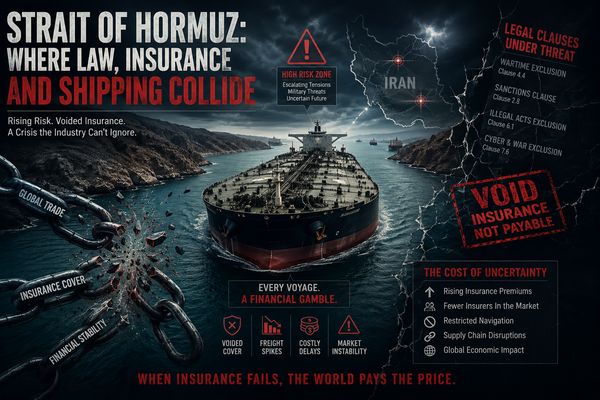 The looming financial storm as Lloyd's anti-toll rule unravels tanker insurance in critical waterways.This image is a conceptual representation and does not depict specific events or actual vessels.
The maritime insurance landscape has undergone a seismic shift, fundamentally altering how geopolitical tensions translate into financial risk for the global shipping industry. No longer are physical blockades the sole deterrent; instead, a new breed of contractual invalidation now freezes operations and liquidates assets with unprecedented speed. This isn't merely about raising war risk premiums; it's about a targeted "financial kill switch" that activates the moment a shipowner complies with local fee demands [4].
How Lloyd's Rule LMA5708 Acts as a Financial Kill Switch for Tankers
On July 23, 2026, the Lloyd's Market Association (LMA) unveiled model clause LMA5708, formally known as the Strait of Hormuz Transit Fee Condition [2]. This clause directly addresses the escalating geopolitical tensions where regional authorities unilaterally impose tariffs or transit fees on commercial shipping navigating international waterways [1]. The LMA's stance is unequivocal: paying these fees constitutes an unacceptable sanctions and counter-terrorism exposure under Western regulatory jurisdictions [1].
Unlike the Joint War Committee's (JWC) List of Areas of Perceived Enhanced Risk, which typically triggers 48-hour cancellation notices forcing premium renegotiations [9][8], LMA5708 introduces an absolute exclusion [2]. Under this clause, underwriters are irrevocably discharged from all liability for the vessel from the precise moment a prohibited payment or consideration is made [2]. This is a critical distinction — it’s not a suspension of cover, but a permanent termination of the contract [4].
According to Arabella Ramage, Legal and Regulatory Director at Lloyd's Market Association, "The clause and guidance have been developed to support the market in navigating a complex and evolving legal and regulatory environment. It provides a clear contractual position for insurers and insureds where transit payments, including non-financial payments, are given in connection with passage through the Strait of Hormuz. The clause and guidance align with existing sanctions and terrorism frameworks, while also evidencing the insurer's due diligence and compliance" [3].
The legal underpinning for LMA5708 is rooted in statutory sanctions compliance and counter-terrorism financing statutes across the United States, the United Kingdom, and the European Union [1]. The model wording is intentionally broad, designed to capture direct payments, indirect transfers via port agents or third-party intermediaries, charterers, and even barter arrangements involving fuel oil [4]. Notably, underwriters are not required to prove the ultimate recipient was a designated entity like the IRGC [4].  The immediate and irrevocable discharge of insurance liability under LMA5708.This image is a conceptual illustration of legal and financial impacts.
A crucial technical nuance lies in distinguishing between compulsory transit tolls and legitimate maritime services, as outlined in UNCLOS Article 26 [2]. This article unequivocally prohibits state authorities from levying charges upon foreign vessels solely for passing through territorial seas or international straits [2]. Charges are permissible only for specific, actual services rendered, such as voluntary pilotage or deep-water towage [2]. "International law provides for the freedom of navigation, which means … basically no payment or toll whatsoever," asserted Anouar El Anouni, European Commission spokesperson [5]. Re-labeling an illegal transit toll as a generic security fee or environmental service does not, in practice, bypass the LMA5708 exclusion [4].
The immediate consequence is legal immobilization rather than physical obstruction [1]. Most commercial tankers are subject to insurance requirements requiring them to maintain Hull & Machinery (H&M), War Risk, and Protection & Indemnity (P&I) coverage [1]. Standard ship financing covenants mandate the vessel maintain full Hull & Machinery (H&M), War Risk, and P&I coverage with top-tier underwriters at all times [1]. When a master pays an unauthorized transit fee, H&M cover terminates instantly under LMA5708 [2]. This immediately terminates H&M cover under LMA5708, creating a significant insurance gap for the vessel and potentially affecting its ability to meet applicable insurance requirements [1].
| Charge Classification | UNCLOS Legal Status | LMA5708 Policy Effect |
|---|---|---|
| Compulsory Passage Toll | Violation of Article 26 [2] | Irrevocable Policy Termination [4] |
| Voluntary Tug Assistance | Compliant with Article 26 [2] | Cover Maintained [2] |
| Non-Specific Security Levy | Violation of Article 26 [4] | Irrevocable Policy Termination [4] |
| Actual Port Pilotage Fee | Compliant with Article 26 [2] | Cover Maintained [2] |
Operational Mandate for Fleet Integrity
Fleet managers must issue explicit operational instructions to vessel masters and port agents, unequivocally forbidding any payment of non-UNCLOS compliant passage charges. Ensure contracts contain express clauses verifying that any toll payment attempted by charterers without underwriter approval constitutes an uncured material breach, safeguarding the vessel’s insurance status.
Why P&I Mutual Coverage Collapses When Primary Hull Insurance Is Voided
Marine insurance fundamentally operates on a stringent two-pillar architecture [10]. Commercial Hull & Machinery (H&M) policies handle primary property damage, while third-party liabilities fall under the purview of mutual Protection and Indemnity (P&I) Clubs [10]. The moment an anti-toll clause like LMA5708 terminates a tanker’s primary Hull & Machinery cover, it creates an immediate and significant gap in the vessel’s insurance protection, with important implications for its broader P&I coverage [1].
The International Group of P&I Clubs comprises 12 clubs that, according to marine law experts cited in the article, provide marine liability cover to 87% of the world’s ocean-going tonnage [6]. These clubs function as non-profit mutual associations, bound by strict bylaws [15]. A foundational principle governing the International Group of P&I Clubs is that P&I coverage forms part of a broader insurance framework, with BMIP offering hull and cargo insurance, P&I, and war-risk coverage, while experts say it should function as a complement to the existing international P&I coverage rather than a replacement [12]. It’s an interconnected ecosystem; if one pillar crumbles, the other cannot stand.
Under standard club rules, should a member's primary H&M policy be voided due to illegal acts, sanctions breaches, or explicit policy violations, the P&I entry is critically compromised [4]. While P&I rules do include an "Omnibus Rule" granting directors discretionary authority for extraordinary operational expenses, this provision explicitly cannot — and does not — override primary insurance failures directly caused by illegal acts [14]. It’s a common misconception that this discretionary clause acts as a universal safety net; in reality, its scope is carefully limited to maintain compliance and financial prudence.
Mike Salthouse, Chair of the International Group Sanctions Committee, clarified that "Trading to Iran is not of itself unlawful as a matter of either EU or US law. Such trades are also subject to the differing legal frameworks of the either the EU and the US towards Ira" [16]. However, when a payment directly violates counter-terrorism financing statutes or explicit anti-toll conditions, the P&I Club's legal ability to process any subsequent claims is entirely removed [1]. This isn't about the legality of trading itself, but the specific, prohibited action of paying unauthorized tolls.
Mutual P&I Clubs are subject to the laws and regulatory requirements of their respective jurisdictions, with the source identifying the UK, Norway, Sweden, Japan, and the EU as the principal jurisdictions involved [1]. If a tanker triggers LMA5708 by making a transit payment to a sanctioned authority, the P&I Club immediately faces severe legal prohibitions [1]. The JWC guidance further highlights that payments or services related to safe passage through the Strait of Hormuz can create significant sanctions exposure, including for non-U.S. persons [11]. The board of an IG Club therefore faces legal restrictions on providing assistance where doing so could facilitate a sanctions violation, while Section 5(a) of the standard IG reinsurance pooling terms excludes claims arising from sanctioned trades or illegal payments [1].
This leaves shipowners directly exposed to third-party liabilities, which in crude oil transport can exceed the commercial value of the vessel itself [4]. Critically, P&I insurance covers third-party liabilities such as oil pollution, wreckage removal and damage done to ports [12]. For perspective, the Bharat Maritime Insurance Pool will provide insurance support for hull and machinery, cargo, protection and indemnity, and war risks, although experts note that its limited capacity may not fully cover large-scale war risk [7]. Without the robust IG Club pooling structure, which provides up to $3.1 billion in coverage per incident, the vessel owner's corporate entity faces immediate and unavoidable insolvency [4].
| Risk Layer | Attachment Point & Coverage Limit | Capital Provider |
|---|---|---|
| Individual Club Retention | $0 – $10 Million [19] | Individual P&I Club |
| International Group Pool | $10 Million – $100 Million | IG Mutual Pool Members |
| General Excess of Loss (GXL) | $100 Million – $2.1 Billion | Global Reinsurance Market |
| Overspill Protection | Up to $3.1 Billion Total Limit | Mutual Overspill Calls |
| Excess War Risk Sub-limit | $500 Million Excess of Vessel Value [12] | IG War Risk Facility |
Auditing P&I Documentation for Continuity
Risk managers must meticulously audit their P&I entry documentation, specifically looking for "fall-away" clauses linked to primary H&M policies. It is crucial to ensure that underlying war risk and primary hull contracts do not contain conflicting termination triggers that could inadvertently void critical third-party liability cover during complex, geopolitically sensitive transits.
The Three Catastrophic Uninsurable Risks Facing Voided Tankers
Operating a crude oil tanker without valid P&I validation strips away every essential operational protection [1]. This loss of P&I protection exposes shipowners, charterers, and cargo interests to three distinct areas of liability associated with operating a crude oil tanker without valid P&I coverage [4]. It’s not just a financial hit; it’s an existential threat to their very ability to operate.
The first, and arguably most devastating, exposure is the $1 billion pollution liability framework [15]. International oil spill compensation relies on the International Convention on Civil Liability for Oil Pollution Damage (CLC) and the International Oil Pollution Compensation Funds (IOPC Funds) [15]. This regime mandates that oil tankers carrying over 2,000 tons of persistent oil must maintain statutory insurance, verifiable by a state-issued "Blue Card" [15]. If a tanker’s P&I coverage is no longer maintained, the statutory insurance certification required under the CLC regime may no longer remain valid, potentially affecting its compliance with the applicable oil-pollution liability requirements [4]. Should an uninsured tanker then suffer a hull breach and spill crude oil, the resulting oil spill can create significant environmental and financial risks [18]. The CLC strict liability tier collapses, and the IOPC Funds will not act as a primary insurer for non-compliant shipowners [15]. The Joint War Committee, comprising underwriting representatives from both the Lloyd’s and IUA company markets, periodically updates and disseminates Listed Areas where vessel owners are required to notify underwriters of voyages [20][1]. 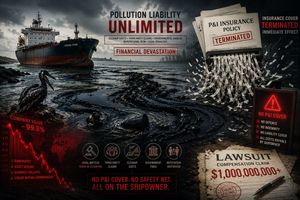 The catastrophic scale of pollution liability and salvage costs when P&I coverage collapses.This image is a conceptual depiction of potential environmental and financial risks.
The second exposure involves increased salvage costs [17]. Increased cost of salvage refers to the higher-than-usual expenses involved in recovering a vessel or its cargo after a marine casualty [17]. As salvage operations can often exceed the insured value of a vessel, those writing hull insurance should be aware of how this can affect premium pricing, coverage limits and the need for deductibles or sub-limits on salvage-related expenses [17]. If the P&I Club cannot provide the required financial guarantee, salvors may decline to commit their assets, leaving the stranded vessel without the expected salvage support and potentially increasing environmental and navigational risks [4]. Under the Nairobi International Convention on the Removal of Wrecks (NWRC), coastal states possess the authority to mandate the complete removal of hazardous wrecks at the owner's expense [21]. Without a valid Nairobi Convention Certificate, a vessel may not be permitted to operate in ports or waters of states that are party to the Convention [21].
The third, equally significant exposure encompasses crew welfare claims, including injury, death, and repatriation, which can be complicated by foreign arbitration processes, regulatory considerations and sanctions regimes [12]. These claims can involve complexities arising from the existing foreign-insurer framework, including issues relating to arbitration, regulation and sanctions [12]. Simultaneously, cargo owners facing an increasingly risky vessel can petition courts for injunctions to seize the vessel or require emergency ship-to-ship cargo transfers [1]. This precarious situation leaves the shipowner exposed to cargo conversion and degradation claims, with the source stating that such claims may be entirely without insurance recourse [1].
Contingency Planning for Crew and Assets
Ship management companies must establish emergency escrow mechanisms capable of independently funding crew wages, maintenance, and repatriation, separate from P&I claims. This proactive measure is essential if a vessel becomes stranded or detained due to policy invalidation, mitigating immediate humanitarian and operational crises.
How Voided Insurance Policies Freeze Letters of Credit and Trade Finance
The profound fallout from insurance invalidation extends directly into international trade finance, where the physical trading of crude oil relies heavily on structured banking instruments, including documentary Letters of Credit (LoCs) issued under UCP 600 rules [1]. The physical trading of crude oil relies heavily on structured banking instruments, predominantly documentary Letters of Credit (LoCs) issued under UCP 600 rules [13]. These aren’t just pieces of paper; they are the bedrock of trust and payment in global commodity movements.
Tier-1 trade finance institutions leverage automated compliance screening systems to detect potential sanctions or irregularities in trade-finance transactions [22]. These compliance and intelligence processes draw on vessel-tracking, AIS monitoring, geospatial analysis, ship-to-ship transfer data, and cross-referencing of ownership and management chains, as well as flag and vessel-name changes, to identify suspicious patterns of behaviour [16]. If a tanker's insurance status shifts from active to cancelled while it's carrying financed cargo, these automated systems flag the vessel instantaneously [4]. The critical alert is that the very collateral backing the loan — the immense oil cargo — is now onboard an uninsured ship, exposing the bank to total loss in the event of a casualty [1].
According to the SITPRO Financial Guide to Letters of Credit, "All parties in the letter of credit transaction deal with documents, not goods" [23]. This highlights a fundamental truth: because parties to a letter-of-credit transaction deal with documents rather than goods, the documents presented must comply with the applicable requirements of the letter of credit [23]. Under UCP 600 rules, banks meticulously examine documents based strictly on facial compliance [13]. However, trade documentation includes transport documents such as Bills of Lading and Insurance Certificates, which may be required as part of the documentation for the carriage of goods by sea [13]. When LMA5708 terminates the vessel’s H&M cover, this insurance invalidation can affect the validity of insurance documentation required under trade-finance arrangements, potentially disrupting the payment chain [4].
Issuing banks promptly refuse to honor sight drafts or process payments under the Letter of Credit [22]. The trade transaction deadlocks, leaving the seller unpaid and the buyer legally unable to claim title to the cargo [22]. This can precipitate what the source describes as a “floating cargo trap” in international waters, with the trade transaction deadlocked, the seller unpaid, and the buyer unable to claim title to the cargo [4]. Destination terminals may therefore become an additional commercial constraint for affected vessels, as the loss of insurance cover can undermine their ability to operate under existing contractual and financing requirements [4]. Terminal regulations stringently mandate active P&I pollution indemnities before granting berthing approval [18]. Consequently, these tankers are forced to anchor offshore indefinitely, accruing crippling demurrage charges that can range between $50,000 and $100,000 daily [8].
| Audit Stage | Verifiable Metric | Automated Banking Outcome |
|---|---|---|
| Vessel Screening | AIS Track vs JWC Listed Areas [9] | Flagged for War Risk Verification |
| Insurance Verification | API Check of IG P&I Active Registry | FAILED if Voided by LMA5708 [4] |
| LoC Document Review | UCP 600 Facial Compliance [23] | Payment Frozen / Sight Draft Refused [25] |
| Cargo Discharge Audit | Terminal P&I Blue Card Validation | Berthing Denied; Offshore Anchor [8] |
Safeguarding Trade with Continuity Clauses
Traders must insert express "Insurance Continuity Clauses" into Cost, Insurance, and Freight (CIF) purchase contracts. These clauses should precisely define alternative payment pathways and escrow mechanics to mitigate financial paralysis if primary marine cover is unexpectedly discharged due to regulatory changes mid-voyage.
Can Sovereign Indemnity Pools and Cape Rerouting Bypass the Insurance Void?
In response to insurance restrictions, fleet operators and importing nations are considering alternative risk-mitigation strategies, including state-backed insurance pools, long-distance rerouting, and regional non-Western insurance markets [1]. These approaches include expanding domestic marine insurance capacity, developing alternative insurance arrangements, and reducing reliance on established international insurance providers [6]. The goal is clear: to maintain trade flows in an increasingly fractured geopolitical landscape.
A prominent example of sovereign risk absorption is India's Bharat Maritime Insurance Pool (BMIP) [6]. Announced on April 18, 2026, and officially launched in May 2026, the BMIP aims to provide crucial coverage for Indian-flagged and controlled merchant vessels, particularly those navigating conflict zones [6]. Administered by the General Insurance Corporation of India (GIC Re), the BMIP operates with an underwriting capacity of ₹950 crore (approximately $114 million) and is significantly backed by a sovereign guarantee of ₹12,980 crore (roughly $1.4B to $1.5B) [6]. This pool covers Hull & Machinery, Cargo, P&I, and War Risks for a mandated 10-year period [6].
Debashish Prusty, Additional Secretary at the Department of Financial Services, stated, "The indigenous pool has already resulted in reduction of premiums for hull war and cargo war risk covers in the country by 27% and 48%, respectively" [6]. However, the economic reality presents a more complex picture. Anil Devli, CEO at the Indian National Shipowners' Association (INSA), highlighted a significant discrepancy: "One of our members sought a quote for BMIP cover. We were told that it is 27% lower than the market. I want to tell you that the quote we have got is 70% more than what we got in London" [6]. This massive pricing disparity underscores the considerable commercial friction encountered when attempting to replace established London market syndicates with national alternatives [6].
"Bharat Maritime Insurance Pool (BMIP) represents a conscious effort by India to reduce excessive dependence on external insurance markets during periods of geopolitical uncertainty," observed Harsh B. Buch, Founding Partner at Orion Counsel [6]. Yet, a critical vulnerability exists: because BMIP relies on a sovereign guarantee rather than substantial liquid cash reserves, international port authorities frequently hesitate to accept its certificates for major pollution liabilities [6]. This is a crucial edge case — a guarantee, however substantial, doesn't always equate to the immediate, tangible financial liquidity demanded by international maritime law and port protocols.
The primary operational alternative involves avoiding the affected Middle East transit routes, although this comes with significant additional costs and insurance considerations [8]. While vessels operating in the affected region face sharply increased war-risk insurance premiums, the extent of the additional cost varies according to the perceived risk of the voyage and the vessel [7]. It is a significant insurance consideration as operators assess voyages through affected high-risk areas [8].
Non-Western regional insurers offer another potential alternative, but the source highlights significant structural challenges: past indigenous marine-insurance efforts have faced inadequate capitalisation and insufficient technical expertise, while BMIP is intended to complement rather than replace established international P&I coverage [6]. Consequently, such regional insurance alternatives may face limitations in matching the established international P&I market [16].
| Operational Parameter | Strait Route (LMA5708 Risk) | Cape of Good Hope Route | BMIP Sovereign Pool |
|---|---|---|---|
| Voyage Transit Delta | Baseline | +10 to +14 Days | Baseline |
| Incremental Fuel / Charter Cost | Baseline | +$1.2 Million | Premium +70% vs London [6] |
| War Risk Insurance Status | VOIDED if Toll Paid [4] | Standard Baseline Coverage | Sovereign Backed ($1.4B) [26] |
| Global Port Acceptance | REJECTED by Terminals [8] | 100% Full Acceptance | Limited Acceptance [6] |
Strategic Rerouting as a Risk Baseline
Logistics managers should calculate the Cape of Good Hope rerouting expense as a mandatory baseline in voyage planning during periods of heightened geopolitical tension. Treating unbacked transits as a viable commercial option introduces unacceptable risk and should be strictly avoided in favor of guaranteed, albeit costlier, safe passage.
Financial FAQ: Navigating Tanker Liability in Complex Waters
What triggers an insurance void under Lloyd's model clause LMA5708?
Why does losing Hull & Machinery cover cancel a tanker's P&I insurance?
Can a shipowner use the P&I Omnibus Rule to cover an uninsured transit breach?
How does a voided P&I policy freeze trade finance Letters of Credit?
Does India's Bharat Maritime Insurance Pool fully replace London P&I coverage?
Disclaimer: This article covers financial topics for informational purposes only. It does not constitute investment advice and should not replace consultation with a licensed financial advisor. Images, charts, and visuals are for illustrative purposes only. Please refer to our full disclaimer for more information.