
China’s Outsourced Children Industry: The Ultimate Demographic Coping Mechanism? 💀🔥
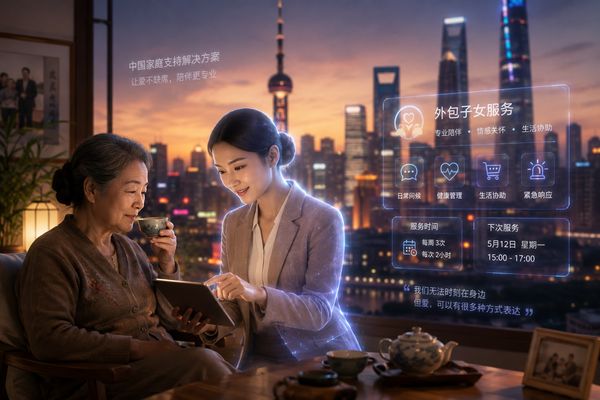 The evolving landscape of elder care in China, where companionship and assistance are becoming purchasable services.Image for illustrative purposes only. The concept depicted represents emerging social services in China, not a literal 'outsourced children' industry.
Here’s what’s blowing up: China's ‘outsourced children’ phenomenon. I know, right? Sounds like something straight out of a sci-fi flick or a dark TikTok meme. Young Chinese adults are literally getting paid to step in and fill some of the roles traditionally handled by adult kids. We’re talking companions for hospital visits, tech support for tricky smartphones, and just, well, presence for older folks.
It’s all over my feed, making everyone ask: is this a canon event for global demographics, or just a wild, hyper-specific China moment?
But hold up. Before you spiral into full-blown dystopian anxiety, let’s peel back the layers. Because the reality? It’s way less dramatic than 'rent-a-kid' headlines make it seem, and honestly, a lot more revealing about what happens when demographics go absolutely wild. 🔥
I. Why are “outsourced children” suddenly a thing in China?
Okay, let’s get this straight: the idea that you can just 'hire a child' in China has gone utterly viral. I mean, my DMs are blowing up. News outlets are reporting that young adults in their 20s and 30s are visiting older clients, chilling, chatting, helping them get their phones to actually work, and even accompanying them to the dreaded hospital or on shopping missions [1].
Compress that into a single, punchy soundbite—rent a son, rent a daughter, rent a family—and yeah, it feels like we’re in an episode of Black Mirror. But the actual vibe? It’s far less grim and way more nuanced. These aren’t stand-ins pretending to be blood relatives. They’re providing a specific, much-needed service: time, presence, practical help, and companionship. The Washington Post calls them “shared” or “outsourced” children, while Chinese reports use terms such as “temporary family members” and “temporary children” [1][6][7].
That distinction? It's everything.
Calling it an 'industry' might make it sound like China just dropped 'Outsourced Children Inc.' on the world. They didn’t. The August 2026 reporting says it’s not clear how widespread these services are, while China’s 2025 central elder-care policy describes a broader system built around home-, community-, and institution-based care and the coordination of different forms of elder-care provision [1][4]. What is documented is a mix of paid companionship services and individual providers: companies such as Time Bank and Happy Home offer companions who visit older people, chat with them, help with everyday tasks such as setting up smartphones, and sometimes accompany them to medical appointments [1][6].
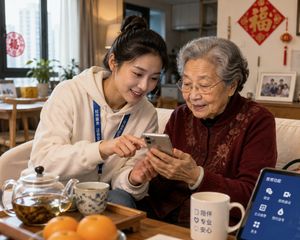 Bridging the digital divide: Paid companions often assist older adults with modern technology.Image for illustrative purposes only. The scene depicts a common service provided by paid companions in China.
The demographic backdrop is enormous
Let’s talk numbers, because China’s demographic situation? It’s the real main character here. By the end of 2025, a jaw-dropping 323.38 million Chinese residents were 60 or older—that's 23.0% of the entire population! And 223.65 million were 65 or older, making up 15.9% [2]. Oh, and the population actually shrunk by 3.39 million in 2025. Wild, right?
These aren't just big numbers; they're structurally important. The World Health Organization (WHO) is predicting China's 60+ population could hit 402 million by 2040, roughly 28% of the population [9]. That doesn’t mean everyone needs a paid companion. It does, however, underline the scale of China's ageing challenge. And here’s a hot take: China’s older population isn’t simply one homogeneous group requiring institutional care. Official policy calls for a graded and classified elder-care system, with home-based care as the foundation, community care as support, and institutional care as professional support, while prioritizing basic care for older people who have lost the ability to care for themselves and strengthening services for disabled and incapacitated older people [4]. This opens up a massive opportunity for diverse services.
Edge Case #1: “Outsourced children” aren't necessarily caregivers
This is where things get super granular. A companion? Not automatically a nurse, doctor, or a certified elder-care pro. The Washington Post explicitly noted that these workers focus on companionship, not specialized medical care [1]. And this distinction becomes absolutely critical, especially in a hospital setting.
A companion might guide someone through registration, help them find a department, wait in line, or remember instructions. But their duties and responsibilities are not clearly defined, and the profession has not yet established uniform qualification requirements [6][7]. So, here’s the real tea: China’s “outsourced children” phenomenon is the commercialization of specific forms of filial support—think companionship, practical assistance, and accompaniment—not the literal outsourcing of parenthood. The viral headlines often miss this critical boundary.
What changed in 2026?
It's not that these services are totally new. Professional medical-companion services were already being documented in China by 2022, with reports describing paid companions helping patients navigate hospitals and one patient describing her companion as a “temporary family member” [7]. So, what’s the real vibe shift?
It’s the visibility and the framing. By August 2026, The Washington Post was linking these services to China’s aging population and describing the young workers as ‘shared’ or ‘outsourced’ children [1]. Language is powerful, and it can turn an obscure service into a cultural phenomenon overnight. Suddenly, 陪诊—medical accompaniment—becomes something much bigger: if your actual child is three provinces away, can money buy back some of the time that distance took away? The answer is increasingly: sometimes. But only sometimes.
Demystify the ‘Industry’
Don't treat “outsourced children” as a single standardized category of elder care in China. The term is used for emerging companionship services in which people are hired to provide social and day-to-day support, but it should be distinguished from formal home-care, professional elder-care, medical services, and volunteer or time-bank programs. These forms of support can address overlapping needs, but the sources distinguish them by the types of assistance they provide [1][4][6].
II. How much does it cost to hire an adult child in China?
Let’s talk price, because everyone wants to know the deets. The viral number you’re seeing everywhere: $29 to $88 for a three-hour session. This figure comes straight from The Washington Post’s August 30, 2026 report on advertised Chinese 'shared' or 'outsourced' children services [1].
The current price snapshot
| Service framing | Reported price |
|---|---|
| “Outsourced/shared child” companionship | $29–$88 / 3 hours [1] |
| Shanghai medical-escort market | ¥200–¥600 / 4 hours in Shanghai, with no unified pricing standard reported in 2024 [25] |
| Shanghai elder medical-escort pilots | about ¥200–¥300 / 4 hours in some 2026 pilots [8] |
| Guangzhou examples | ¥300 / 4 hours; ¥500 / 8 hours in one 2025 survey [10] |
Now, a major red flag for all my data nerds out there: don’t even think about merging these figures into one national price list. These are snapshots from different cities, different service models, different dates, and different providers [1][6][8][10]. The $29–$88 range? That’s for the “shared” or “outsourced” children services that provide companionship and everyday assistance [1]. Medical escorts? Totally different pricing. Government-subsidized programs? Free or heavily discounted. So, the question isn't 'How much does a Chinese adult child cost?' It’s more, 'How much does a household pay for a specific block of assistance?' Very different economic flex.
"There are prospects here, but it seems there’s still much that needs to be done,”
Why three hours?
Honestly, three hours just makes sense for companionship and many appointments. You’re not buying round-the-clock care, you’re buying a specific, defined time block. That could include visiting an older client, chatting, helping with a smartphone, accompanying them on errands, or assisting them with medical appointments and hospital procedures [1][6][7].
In medical settings, time is money, especially with all the waiting, department transfers, and administrative hoops. A Shanghai report found that four-hour medical-escort services were priced at around ¥200–¥300, with pricing standards varying among service providers and customized services subject to market-adjusted pricing [8].
Edge Case #2: The headline price isn't necessarily the final price
Here’s another nuance that often gets lost in the buzz: a basic companionship session and specialized medical accompaniment are not the same thing, economically speaking. A service that includes transport, extended hospital waiting, highly specialized staff, night-time work, or extra errands is going to cost more. Chinese medical-escort reports have found that prices can vary by service and location, with some providers negotiating fees privately, while the industry has lacked a unified pricing standard [6][7]. So, don't get finessed by a headline number—it’s never the whole story.
Who actually pays?
This is where it gets really interesting. The older person isn’t always the one footing the bill. Sometimes, it’s the adult child. This creates a three-sided dynamic: the older parent receives the service, the adult child pays for it, and the companion worker provides it. That totally flips the economic script.
An adult daughter living in another city isn’t buying companionship for herself. She’s buying reassurance that someone can physically be there when she can’t. The Washington Post profiled Janice Ye, a teacher in Suzhou who hires Time Bank companions to visit her parents in Anhui [1]. This isn't just a transaction; it's a distance-management service. You're buying proximity, not a literal replacement relationship.
And this is where “filial piety” gets complicated
The obvious question: does paying someone else to visit your parents totally undermine 'filial responsibility'? It’s not a simple yes or no. China's government actually promotes a mixed system where family, community, institutions, and professional providers all coexist [4]. Their 2025 policy is crystal clear: home care as the foundation, community care as support, and institutions for the pros [4].
Modern elder care is already a multi-actor system, with families, government, communities, professional providers, social organizations, volunteers, long-term-care insurance and market-based services incorporated into the broader elder-care framework [4]. The 'outsourced child' just pushes that logic into a super emotionally charged space.
Compare Apples to Apples
If you're comparing prices, compare services on a like-for-like basis. The reporting describes paid companionship sessions separately from other forms of elder-care provision, so their prices should not be treated as directly equivalent without accounting for differences in the services provided [1][6].
III. What do outsourced children and companion workers actually do?
Forget the meme for a hot minute. The actual service menu? It’s surprisingly… ordinary. And that’s precisely why it works! As Sun Shuyang, a companion worker with Happy Home in Tianjin, puts it, 'By talking to young people like us, they can regain a sense of vitality and feel more energetic' [1].
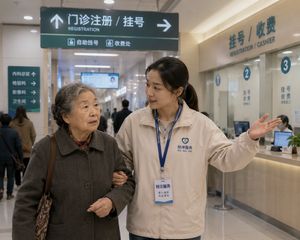 Navigating complex hospital environments is a key service offered by companions.Image for illustrative purposes only. This portrays a common assistance service in Chinese medical settings.
🏥 Hospital navigation
One major task: accompanying older people to medical appointments, helping them navigate the confusing maze of hospital departments, waiting with them, and assisting with all the administrative steps. Chinese medical-escort reports detail services like registration, payment, examinations, medication collection, and organizing information for communication with doctors [6][7]. The problem isn’t always medical; it’s often about pure complexity. Hospitals can be physically tough to get around, and for someone not used to digital registration, a physical presence makes all the difference.
📱 The tech bridge
Smartphones are basically glued to everyone’s hands in China, even for healthcare and public services. But older adults? Not always as tech-savvy. A study using data from the 2021 China General Social Survey found that only 35.25% of Chinese adults aged 60 and over used the internet, compared with 89.09% of those under 60 [13]. That gap isn't just about entertainment; digital exclusion can also leave older adults less able to use mobile payments and other everyday digital services [14]. So, helping someone set up their phone? That’s not just tech support; it’s access support.
🛒 Everyday errands
Reports on “shared-child” services describe companionship, visits, help with smartphones, and accompaniment to medical appointments, while China’s broader elder-care system includes home-based services such as meal assistance, bathing, cleaning, mobility assistance, and medical assistance [1][4]. These tasks are often low intensity but high friction. Buying a new appliance doesn’t need a nurse. Getting an older person safely to the store doesn't require a nursing home. But it absolutely requires somebody.
☕ Pure companionship
This is the part that hits different. Sometimes, the companion just… talks. Sits. Listens. Sips tea. Goes for a walk. It’s not medical care, not housekeeping, not therapy. It’s simply human presence, delivered as a paid service. The WHO highlights loneliness and social isolation as important social determinants of health, noting that around 11.8% of older people experience loneliness and that these conditions can seriously affect physical and mental health, quality of life, and longevity [15]. China isn't uniquely lonely, but it does have a uniquely large aging population. And that combo? A market opportunity.
The hidden product: reliability
Here's the technical nuance most viral takes miss: people aren’t just paying for conversation. They’re paying for reliability. A daughter living far away can call, but she can’t physically escort her mom through a hospital. A video call can’t carry groceries. A text can’t always tell you if an elderly parent is really doing okay. A paid worker can. This service sits at the intersection of companionship, logistics, and care.
Edge Case #3: The “emotional service” isn't automatically mental-health treatment
Another crucial boundary: a companion who listens isn't automatically a psychologist. The WHO identifies loneliness and social isolation as important social determinants of health and highlights interventions such as community and support groups, befriending, and social skills training to reduce them [15][16]. So, marketing 'companionship' as psychotherapy? Hard no. That's not just semantics; it's a professional line you shouldn't cross.
Define the Task, Verify the Pro
When evaluating a companion service, define the task before paying: companionship, transport, errands, hospital navigation, personal care or clinical support. If a service involves professional nursing or other specialized medical services, verify the provider's qualifications rather than assuming “companion” means “health professional” [6][7].
IV. Is the 4-2-1 family structure really behind China's elder-care problem?
Partly, yes—but the popular narrative needs a serious vibe check. The phrase 4-2-1 family structure describes a specific demographic setup: four grandparents, two parents, and one child. Researchers have studied this family structure in relation to China’s one-child policy and the implications it may have for family and old-age support [17]. The math looks brutal: one generation potentially on the hook for four older family members, plus two parents, plus their own child. 💀
But real families aren't just spreadsheets. Senior family members may be healthy, may require care because of serious illness, or may have died. Plus, not every family has just one child—the 4-2-1 structure is changing as China’s fertility policies have been relaxed, and the one-child policy was abolished after decades of enforcement [19]. So, 4-2-1 is a model, not a universal truth. A 2024 study in BMJ Global Health by Xiaoxiao Kwete and colleagues found approximately 60 million working-age women grappling with medium-to-high care responsibilities [19]. That’s some undeniable proof linking China's demographics to caregiving pressure, especially for women born under the one-child policy who lacked siblings to share the load.
The sandwich generation isn't just a slogan
Being part of the 'sandwich generation' means you're stuck between caring for older family and raising your own kids. In China, this can be extra spicy because the one-child policy meant fewer siblings to divvy up caregiving duties. The BMJ Global Health study found that the added burden of fewer siblings actually outweighed the benefit of having four grandparents who might help with childcare [19]. It’s a strange generational flip: grandparents help raise grandkids, but then those same grandparents might need care, often when the middle generation is still raising their own children. Talk about a core memory!
Then add work
China’s national stats office reported that enterprise employees averaged a whopping 48.6 hours per week in 2025 [3]. Now, that doesn't mean everyone’s clocking those hours, or that long workweeks caused the outsourced-child trend. But it screams one thing: time is scarce. And caregiving? It's a time vampire. Hospital visits, errands, phone lessons, just listening to a parent for a couple of hours—it all eats up precious time. So, when households have the cash but are running on empty in terms of hours, the market for these services becomes super attractive.
Edge Case #4: The “4-2-1 crisis” is becoming more complicated, not simply worse
Here’s the plot twist: China's family structure is evolving again. The BMJ study describes the traditional 4-2-1 structure as shifting toward more complex configurations, including families with multiple children [19]. This means the future isn’t necessarily 'one child forever supporting four grandparents.' Some younger households have siblings, some have multiple children, some have none. Parents live thousands of kilometers from their kids, some older people live alone, some with spouses, and some have tight community networks. The result? Not one crisis, but a complex care mosaic.
Distance matters
Urbanization and migration add another layer of complexity. China had 301.15 million rural migrant workers in 2025 [3]. Migration doesn't mean older parents are abandoned, but it does create physical separation. That's exactly where a paid local companion becomes a lifesaver. Kids don’t want someone to be their parent; they need someone to be there when they can't. That’s a far less sensational, and far more logical, interpretation.
Why women matter disproportionately
The BMJ study also highlights the disproportionate share of unpaid care work carried by women in China, citing ILO evidence that women perform 71.6% of total unpaid care work. The pressure is particularly pronounced among women born under the one-child policy [19]. This changes the economics of outsourcing dramatically. When a household buys care, they’re not just buying convenience; they’re buying back a portion of someone's working time. This has huge implications for careers, labor force participation, and household income, especially when unpaid care often falls squarely on women.
Refine Your Understanding of 4-2-1
Don't use “4-2-1” as a blanket description of every Chinese family. Use it as a demographic model of caregiving pressure, then laccount for factors such as sibling availability, household composition, migration, and the health status of older relatives. Actual family structures can take many forms [17][19].
V. Does China's elder-care system have a gap big enough for outsourced children?
Absolutely—but let's not act like the system has completely imploded. China is actually building a pretty formidable formal elder-care infrastructure. The real question is whether that infrastructure can cover all the everyday, localized, and yes, emotional needs. As Bingqin Li, an economist and social-policy scholar at the University of New South Wales, wisely says, 'The priority… should be to build a well-regulated care system with clear professional standards,' where volunteers and commercial providers complement formal services, not replace them [1]. That distinction? Critical.
China is not starting from zero
For real, China has been on a glow-up when it comes to elder care. By the end of 2025, they had 395,000 elder-care institutions and facilities, with 7.679 million elder-care beds [12]. We’re talking registered institutions, community facilities, regional service centers, and home-based services. The long-term-care insurance system also had more than 13,000 designated service institutions and about 402,800 care-service personnel [12]. The government’s been pushing a clear three-layer model: home care as the foundation, community care as support, and institutions for professional stuff [4][12].
Their 2025 central policy is super explicit about this architecture, encouraging professional organizations and online platforms to offer services like meal assistance, bathing, cleaning, and emergency help [4]. So, here’s the twist: 'outsourced children' aren’t necessarily a sign of a failing elder-care system. They could actually be evidence of the system becoming more diverse and pluralistic.
Why doesn't everyone simply use a nursing home?
Because nursing homes solve a different problem. They offer structured accommodation and care. But most older adults would rather stay home, and Chinese policy itself aims to strengthen home and community care alongside institutional services [4][11]. A healthy 72-year-old wanting a museum buddy doesn't need a nursing home. A 67-year-old whose kid is in another city might not need residential care. A widowed 80-year-old needing help navigating a hospital twice a month? They need a person, not a bed. That’s where companionship fits perfectly.
The infrastructure gap is often about granularity
This is the underrated tea. Big systems are great for standardized needs. But families? They need weirdly specific things. 'Can someone take my mom to the hospital at 8 a.m.?' 'Can someone teach her WeChat?' 'Can someone sit with my dad for three hours while I’m working?' 'Can someone make sure she gets home safely?' These aren't institutional problems; they’re micro-logistics problems. And markets? Markets are usually awesome at micro-logistics.
China is also expanding financial support
The policy isn't just “families, you’re on your own!” In 2025, the Ministry of Civil Affairs and Ministry of Finance launched a pilot elder-care consumption subsidy program for older people assessed as moderately, severely, or completely disabled [5]. The program covers home, community, and institutional elder-care services, with central and local government funds providing subsidies for eligible services [5]. This is huge because it shuts down the simplistic narrative that China is just privatizing everything. The state is actively supporting parts of the care market.
Long-term-care insurance is another piece
China's long-term-care insurance system has also blown up. By 2025, 308.55 million people were enrolled, with 1.929 million receiving benefits. The system boasts 13,000 service institutions and 402,800 care workers [20]. These numbers prove China is building formal financing for care, not leaving families to fend for themselves. But here’s the technical nuance: long-term-care insurance isn't companionship insurance. Someone can need social contact without qualifying for a long-term-care benefit. They can need phone help without being disabled. They can need an appointment escort without needing institutional care. That’s where small, paid services carve out their niche.
The wealth divide is the uncomfortable part
Okay, let’s talk about the biggest ethical dilemma. Imagine two older, equally lonely people. One has kids living nearby. The other has kids far away but enough cash to buy regular companionship. The second person can essentially convert money into what the first receives through family proximity. Now, imagine a third person with neither nearby kids nor money. That’s where market-based filial support gets unequal, fast. China’s wider “silver economy” also faces purchasing-power constraints: a 2021 national survey found that older Chinese adults had a median annual income of about ¥11,400, while the figure in rural areas was less than half of that [11]. So, the $29–$88 price tag may be manageable for some people, but affordability is far from universal [1][11].
Edge Case #5: Government subsidies can change the equation
This is why the phrase 'privatization of filial piety' needs major caution. China isn’t just dumping everything from families onto private companies. It’s building a mixed system: government funding, insurance, community groups, volunteers, and commercial providers [4][5][20]. The real flex is whether all these pieces can actually coordinate effectively.
And then there's trust
An outsourced child gets access to someone’s home, their phone, their documents, potentially even their personal info. That’s not some hypothetical risk. The Washington Post report from August 2026 quoted commentator He Yong warning about workers encountering important documents, and also flagged concerns about a lack of professional medical training [1].
But providers are already stepping up with safeguards. Time Bank and Happy Home told the Post they screen and train workers, and Time Bank even reportedly uses same-sex matching and body cameras (with client consent!) to document interactions and resolve disputes [1]. That might sound like a minor operational detail, but it’s huge. The second a stranger enters an elderly person’s home, companionship instantly morphs into a trust-and-safety business.
The platform problem
Medical-escort services have already faced regulatory headaches. Chinese reports have highlighted differences in provider requirements, pricing, and service arrangements, while Shanghai’s new rules also prohibit companion-service providers from using the service as a pretext for unauthorized appointment additions or selling medical appointment slots [6]. This highlights a fundamental distinction: a platform can sell access, but it can’t automatically guarantee competence. A slick app doesn't magically turn a worker into a nurse. A five-star rating doesn't establish medical qualifications. And a super friendly companion might be totally unqualified to make clinical decisions.
Navigate the Care Stack
Think of China's care system as a stack, not a single product: family support + community services + professional care + insurance + government subsidies + volunteer networks + commercial companionship. The safest model is complementary, not substitutional [1][4][5][20].
VI. Could outsourced children become China's ultimate demographic coping mechanism?
Not by themselves. But they could absolutely become one small, crucial component of a much bigger demographic adaptation. As Liu Cheng, founder of Time Bank, put it so perfectly, 'shared children are no replacement for family' [1]. That, my friends, is probably the most important sentence in this entire saga. Because the business doesn’t need to replace family to be genuinely useful. It just needs to cover the hours family can’t.
Japan has faced a related social challenge
Japan’s aging population is no secret. Social isolation and loneliness have become major policy concerns globally, and the WHO has called for policymakers to treat social connection and social health with greater urgency [16]. But Japan’s solution wasn’t just 'hire a child.' Instead, they built extensive systems around long-term care, community support, and formal caregiving. The lesson? Aging societies consistently realize that family care alone just doesn't scale forever.
South Korea shows the loneliness side
South Korea offers another interesting parallel. OECD data from 2023 showed 24% of Koreans aged 60 and over reported feeling lonely [21]. Perceived social support for those 70 and above was way lower than the OECD average [21]. It’s a stark reminder that this isn’t just a China problem. Aging, smaller households, migration, living alone, changing work patterns, weakening social networks, digital dependence—these forces are combining everywhere. China’s unique spin is commercializing one very specific piece of the puzzle: human presence.
Europe has the same underlying issue in a different wrapper
Even the EU is dealing with loneliness and changing household structures. A 2025 European Commission analysis found that single adults without children increased by 17% over the last decade, compared with a 6% increase in the total number of households. The group is also more likely than the overall adult population to be at risk of poverty and to feel lonely [22]. While Europe's solutions vary wildly due to different welfare states and family structures, the core problem is painfully recognizable: people can be surrounded by infrastructure but still lack someone who is actually there. That’s the market opportunity these companionship businesses are laser-targeting.
The “emotional economy” is bigger than elder care
Reuters reported in June 2026 that China’s broader companionship economy—think paid partners for hiking, dining, or sightseeing—is a visible trend, estimated by state media to be around 50 billion yuan in 2025 [23]. This is fascinating because the elder-companion trend isn't happening in isolation. It's part of a wider Chinese economy where people are increasingly paying for social experiences that used to be informal. And this is where technology steps in: platforms make workers discoverable, messaging makes coordination easy, digital payments remove friction, ratings build reputation, and scheduling turns human availability into inventory. The same digital infrastructure that powers food delivery can, theoretically, make companionship bookable. But here's the limit: a human being isn't a hamburger.
Can AI solve this instead?
China is already leaning into tech for older adults and smart elder care [4][9]. AI systems, monitoring devices, and care robots might handle some practical stuff eventually. But companionship? That’s different. A robot reminds you about meds. A digital assistant answers questions. An AI can hold a conversation. None of that proves it can replicate the value of a genuine human connection. The WHO emphasizes the importance of high-quality social connections and identifies interventions such as befriending, community and support groups, and social skills training [15][16]. The realistic future? Technology will likely augment human care, not eliminate the need for human connection.
The biggest misconception: “China is replacing children with strangers”
Hard no. The evidence just isn't there. What we do see is much narrower: some Chinese families are using paid workers for specific, traditional adult-child functions, especially when those children live far away or are super time-constrained [1][6][7]. That is fundamentally different from replacing an entire family. A companion doesn’t share family history, childhood memories, or inherent emotional authority. They can’t make every medical decision, aren’t legally a child, and can disappear when the contract ends. That contractual nature is both its strength and its biggest limitation.
So can money substitute for kinship?
Only partially. Money can buy time, transportation, attention, physical presence, practical assistance, social activities, hospital navigation, and tech help [1][6][7]. But it absolutely cannot buy biological history, genuine intergenerational memory, or guarantee love. And it definitely can't erase the emotional complexities of family responsibility.
Here’s the uncomfortable truth, though: families have never supplied every single form of care themselves. Modern societies already outsource childcare, housekeeping, nursing, transportation, food, and medical care. China’s 'outsourced children' trend is wild because it crosses that final psychological boundary: companionship itself becomes a service. That's why everyone’s reacting so strongly. It’s not just about labor; it’s about intimacy.
The 2030 question
China's government has already set its trajectory: expanding elder-care infrastructure, including community services and mutual-aid models [4]. The goal isn’t to eradicate family care. It’s to build a system where family, community, and professional services coexist. So the most credible future isn't 'Family disappears, paid child replaces it.' It’s 'Family + community + professionals + technology + insurance + volunteers + paid companions.' Less viral, I know. But infinitely more plausible.
The final verdict
So, is China’s outsourced children industry the ultimate demographic coping mechanism? No—not yet, and the evidence doesn't justify calling it one. It's better understood as a new form of paid companionship emerging alongside China’s broader elder-care system [1][4]. Its rise makes total sense: China’s demographics are shifting fast, working adults are putting in substantial hours, and many older adults face a digital divide when navigating increasingly online systems. Meanwhile, research shows that caregiving responsibilities can put substantial pressure on families [2][3][13][19]. The real story isn't that Chinese families suddenly stopped caring. It’s that care has become too complicated to fit neatly inside the family anymore. And once that happens, markets inevitably start selling pieces of it: a hospital escort here, a smartphone lesson there, a three-hour conversation, a shopping trip, a walk, a person who just shows up. That’s the quiet revolution. Not the replacement of children, but the unbundling of what children used to do. And that, my friends, might just be the most important demographic lesson China is accidentally exporting to the rest of the aging world.
Build a Diverse Care Network
The better model isn't “hire someone to become your child.” It's a care system where community volunteers and commercial providers complement, rather than replace, formal services, while family remains part of the picture [1][4].
Key Clarifications & Important Nuances
Misconception 1: “Outsourced children” is China's official name for an industry.
It isn't. The phrase is a media description used for certain companionship businesses. The August 2026 reporting describes these workers as providing companionship and day-to-day assistance rather than specialized medical care, while Chinese reporting uses the term 陪诊师 for people who accompany patients and assist with practical tasks during medical visits [1][6][7].
Misconception 2: Every companion is a medical professional.
False. The August 2026 reporting specifically distinguishes companionship from specialized medical care, while Chinese reporting on medical-escort services highlights professional qualification requirements for people providing these services [1][6].
Misconception 3: $29–$88 is China's universal price.
No. That is the range reported by The Washington Post for advertised three-hour sessions in the “shared/outsourced children” phenomenon. These services provide companionship rather than specialized medical care, so the $29–$88 figure should not be treated as a general price for medical-escort services [1][6].
Misconception 4: Time Bank is simply a government “time bank” volunteer program.
Not in the context of the August 2026 story. The Washington Post describes Time Bank in Suzhou as a commercial organization that hires out shared children. Separately, China has volunteer time-banking programs in which participants earn and redeem service credits [1][24]. Those concepts should not be conflated.
Misconception 5: China has abandoned family-based elder care.
The opposite is closer to the policy direction. China's 2025 central elder-care policy explicitly strengthens home-based care while connecting it with community and institutional services [4].
Misconception 6: 4-2-1 means every Chinese adult has four grandparents to support.
No. It is a demographic model describing a family configuration associated with China's one-child era. Actual family structures vary substantially [17][19].
Misconception 7: Paid companionship automatically solves loneliness.
No. The WHO identifies loneliness and social isolation as important social determinants of health and points to interventions such as community and support groups, befriending, and social skills training [15].
Edge Case #6: The payer may be the adult child, not the older person.
The 2026 reporting provides a clear example of adult children hiring companions for parents who live elsewhere [1]. This makes outsourced companionship partly a distance-management product, rather than simply an elderly consumer buying entertainment.
Edge Case #7: The most valuable service may be “showing up.”
A large part of the model isn't specialized labor. It's physical presence at a time when family members are unavailable. The reporting describes these companionship services as offering companionship and day-to-day assistance, while China’s elder-care policy calls for coordination among home-, community-, and institution-based care [1][4].
What happens next?
Okay, so what’s the future vibe check for this whole 'outsourced children' thing? The responsible answer is less dramatic than a viral prediction, but way more useful. The Washington Post reports that it’s still unclear how widespread these services are [1].
But here’s what we do know is trending: China's older population is massive and growing [2][9]. The government is expanding home and community elder care [4][12]. Long-term-care insurance is expanding nationwide, with 308.55 million people enrolled by the end of 2025 and 1.93 million people receiving benefits [20]. Digital divides for older adults are still a thing [13][14]. China’s workforce is facing some serious time crunch [3]. And commercial companionship is just one piece of a larger 'companionship economy' [23].
So, stack all those facts together, and the strongest conclusion is super straightforward: the demand for services that help families bridge distance, time, and everyday care needs isn’t going to disappear just because the phrase 'outsourced children' stops trending. The branding might change, the platforms might pivot, workers might get more pro, and some services might shift to community or government programs. Others will stay private. But the underlying demographic problem? That’s not going anywhere just because the meme does.
Bottom line
The strongest evidence doesn't show that China has invented a wholesale replacement for children. It shows something subtler: some forms of companionship and elder care traditionally provided within families are increasingly being offered as paid services [1][4][19]
That makes “outsourced children” less a bizarre demographic hack than a visible symptom of a much bigger transition: China is moving from a model where families are expected to provide most practical support toward a mixed care economy in which family, state, community, technology, volunteers, insurance and markets increasingly share the load. [4][5][20]
And that is the real story worth watching. The real story isn't that Chinese families suddenly stopped caring. It's that care has become too complicated to fit neatly inside the family anymore. And once that happens, markets inevitably start selling pieces of it. A hospital escort here. A smartphone lesson there. A three-hour conversation. A shopping trip. A walk. A person who shows up. That's the quiet revolution. Not the replacement of children. The unbundling of what children used to do. And that may be the most important demographic lesson China is accidentally exporting to the rest of the aging world.
Trending Now Insights: Decoding China's Demographic Future
What is China's outsourced children industry?
How much does it cost to hire an outsourced child in China?
Can an outsourced child make medical decisions for an elderly client?
Is China's 4-2-1 family structure still universal?
Can paid companions replace family members?
Disclaimer: This article addresses trending topics and current events for general informational purposes only. The content may reflect public interest or opinion and has not necessarily been independently verified. Images and visuals are illustrative and may not depict real or official events. For complete details, please review our full disclaimer.