
Alibaba Qwen's Dominance: Why it Overtook Meta and Google in Open AI Downloads
 Alibaba Qwen's AI models have surged past competitors in global open-source downloads, marking a significant shift in the technological landscape.The image illustrates Alibaba Qwen's lead in AI models, symbolizing a shift in technological dominance.
The Unforeseen Ascent of Alibaba Qwen in the Open AI Landscape
The landscape of open-weight large language models (LLMs) has undergone a profound, yet often overlooked, reorientation, shifting decisively towards foundational models originating from Asian research labs. This isn't merely a geographic pivot; it represents a fundamental recalibration of priorities within the global developer ecosystem. Early open-source initiatives from Silicon Valley, while groundbreaking, frequently adopted an English-centric evaluation bias, inadvertently creating significant efficiency deficits for international enterprise deployments operating across diverse linguistic terrains. Alibaba’s Qwen, however, systematically addressed this critical deficiency by engineering a fleet of parameter-optimized models designed to perform robustly on standard server configurations, thereby democratizing access and utility on a global scale.
This deep-dive analyzes the strategic advantages, architectural innovations, and market dynamics that propelled Alibaba Qwen to surpass industry giants like Meta’s Llama and Google’s Gemma in global open AI downloads. We'll explore the often-underestimated factors—from licensing strategies to hardware accessibility—that have reshaped the competitive terrain and examine the internal challenges that, paradoxically, underpin its success.
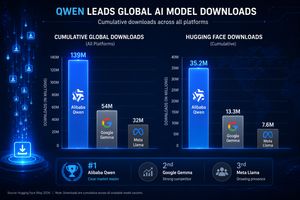 Alibaba Qwen's downloads on Hugging Face drastically outpace those of Google Gemma and Meta Llama, as of 2026, showcasing its rapid market penetration.The image visually compares AI model downloads for Alibaba Qwen, Google Gemma, and Meta Llama.
How Did Alibaba Qwen Surpass Meta Llama and Google Gemma in Global Downloads?
The global developer ecosystem has, in a relatively short span, witnessed a significant structural shift towards open-weight foundational models primarily originating from Asian research labs. This isn't just about regional development; it’s about a proactive approach to addressing previously unmet global demands. A common misconception in the early days of open AI was that models developed by Western tech giants would naturally dominate the global market due to their initial momentum and perceived technological superiority. However, a deeper look reveals that restrictive licensing and an English-first evaluation bias created unforeseen barriers to adoption, particularly in non-Western markets.
Metrics published by Hugging Face provide a stark illustration of this shift. In 2026, Qwen models recorded about 2.045 billion downloads on the Hugging Face Hub alone[1]. To put this into perspective, Google’s models recorded about 418 million downloads, while Meta’s models recorded about 227 million downloads over the same timeframe[1]. Across all global distribution platforms, including China’s ModelScope, Qwen’s cumulative downloads surpassed 3 billion, making it the world’s most-downloaded open AI model family[1].
This unprecedented download velocity was evident in early 2026, with Qwen averaging roughly 1.1 million downloads per day during peak periods. By January 2026, Qwen had surpassed 700 million downloads on Hugging Face, and by March, cumulative downloads on the platform had approached 1 billion[2]. The consumer-facing Qwen application beta further underscored this demand, reaching 10 million downloads within seven days of its release[2].
Beyond raw download numbers, Qwen’s utility as core software infrastructure is evident in its downstream integration. On Hugging Face, developers have built 151,448 derivative models based on Qwen[1]. This is significantly higher than the number of derivative models associated with Meta’s Llama and Llama repositories[1]. Globally, Alibaba’s more than 460 Qwen models have spawned more than 300,000 derivative models[1]. This extensive derivative ecosystem is a critical, yet often overlooked, indicator of genuine developer adoption and practical application, demonstrating that Qwen isn't just downloaded—it's actively built upon and integrated into diverse projects.
Key contributor Kaixin Li from Alibaba Qwen reflected on the project's journey, stating, "Signing off from Alibaba. Grateful for the chance to work with such brilliant minds. Proud of our impact. Onwards and upwards!"[10]. This sentiment highlights the communal effort and inherent value recognized by those directly involved in its development and deployment.
Standardize for Ecosystem Longevity:
Enterprise engineering teams should prioritize base model selection on architectures backed by large derivative ecosystems. This strategy guarantees long-term tooling compatibility, fosters community-driven optimizations, and ensures robust integration with existing open-source hosting stacks, mitigating future technical debt and fostering innovation.
What Architectural Advantages Give Qwen Superior Multilingual and Efficiency Metrics?
At the heart of Qwen’s impressive performance, especially in multilingual contexts and computational efficiency, lies its sophisticated architectural design. One fundamental, yet often underestimated, factor is sub-word tokenization. Traditional English-centric tokenizers, while effective for their target language, often struggle with non-English text. They tend to split non-English words into multiple sub-tokens, dramatically increasing memory footprint and computational cost. Qwen, however, utilizes an advanced vocabulary tokenizer that processes non-English text with significantly fewer tokens than Llama[4]. This seemingly minor technical nuance has profound implications for global deployments, allowing Qwen to operate far more efficiently in diverse linguistic environments.
Beyond efficient vocabulary encoding, Qwen3-8B uses Grouped-Query Attention (GQA), with 32 attention heads for Q and 8 for KV[7]. Qwen2.5 models support context lengths of up to 128K (131,072) tokens, while Qwen3-8B supports a context length of 32,768 tokens natively and up to 131,072 tokens with YaRN[5][7]. Qwen3-8B also supports 100+ languages and dialects, with strong capabilities for multilingual instruction following and translation[5].
Alibaba further expanded Qwen’s adoption by releasing domain-optimized model lines alongside general-purpose checkpoints. For instance, Qwen2.5-Coder has been trained on 5.5 trillion tokens of code-related data, enabling even smaller coding-specific models to deliver competitive performance against larger language models on coding evaluation benchmarks[8]. Similarly, Qwen2.5-Math incorporates various reasoning methods, including Chain-of-Thought (CoT), Program-of-Thought (PoT), and Tool-Integrated Reasoning (TIR)[8].
Recent Qwen3 model releases support both thinking and non-thinking modes, enabling the model to handle complex reasoning tasks as well as low-latency dialogue[7]. Qwen3.6-27B introduces a thinking-preservation option that retains reasoning context from historical messages, streamlining iterative development and reducing overhead. The preserve_thinking option can be enabled to retain this reasoning context, which can be particularly beneficial for agent scenarios by enhancing decision consistency and, in many cases, reducing overall token consumption by minimizing redundant reasoning[12].
The project’s foundational focus on computational linguistics is evident in its architectural design. Junyang Lin, the researcher who led Alibaba’s Qwen models, wrote: “I studied linguistics because my friend recommended pragmatics to me”[13]. This academic grounding in language's intricacies undoubtedly contributed to Qwen's linguistic prowess.
Optimize Agent Pipelines with Dual-Mode Reasoning:
Infrastructure leads should implement dual-mode reasoning architectures in enterprise agent pipelines. Reserve full chain-of-thought processing for genuinely complex logical tasks, while executing routine chat and API routing in high-throughput non-thinking modes. This optimizes computational resources and enhances responsiveness.
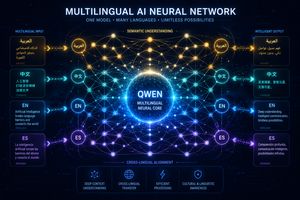 Qwen's advanced sub-word tokenization and Grouped-Query Attention (GQA) enable superior multilingual processing and computational efficiency, reducing memory footprint across diverse scripts.The image depicts Qwen's architectural design for enhanced multilingual and efficient AI processing.
Why Are Open-Weight Licensing and Hardware Accessibility Driving Global AI Adoption?
The often-understated twin pillars of open-weight licensing and hardware accessibility have emerged as critical determinants in accelerating global AI adoption, a factor frequently misjudged by market entrants. Enterprise legal compliance, surprisingly, represents a primary—and often insurmountable—barrier when organizations attempt to integrate open-weight foundation models. Llama 3.1 is available under a custom commercial license, the Llama 3.1 Community License[6]. The Llama 3.1 Community License allows for specified use cases, while certain uses are prohibited by the Acceptable Use Policy and the Llama 3.1 Community License[6].
Alibaba distributed the overwhelming majority of Qwen models, including Qwen2.5-7B, 14B, and 32B, under the widely accepted Apache 2.0 license[4]. The overwhelming majority of Qwen models, including Qwen2.5-7B, 14B, and 32B, are distributed under the Apache 2.0 license[4]. This strategic choice allows organizations to host, modify, fine-tune, and commercialize model checkpoints without burdensome operational user caps or the need for separate commercial agreements. This is a crucial edge case that differentiates Qwen, fostering trust and enabling widespread commercial use without hidden complexities.
Complementing its licensing strategy, Qwen's hardware deployment requirements further democratized access and dramatically expanded its global user base. Meta’s Llama 3.1 collection comprises pretrained and instruction-tuned generative models in 8B, 70B, and 405B parameter sizes[6]. While powerful, this strategy inadvertently created a significant gap in the mid-tier server hardware requirements of countless organizations and individual developers. Developers downloading the Alibaba Qwen Model variants can choose sizes from 0.5B to 72B parameters[3].
This granular approach is a masterstroke in hardware accessibility. Mid-sized configurations such as Qwen2.5-14B and Qwen2.5-32B have been open-sourced, with the Qwen2.5 series addressing interest in the 10–30B parameter range for production use[5]. Qwen3.5’s four compact models, ranging from 0.8B to 9B parameters, are capable of vision understanding and reasoning mode-switching and can run on a consumer laptop with 7GB of RAM[11]. This unparalleled hardware accessibility fundamentally democratizes deployment, eliminating the need for specialized compute clusters or prohibitively expensive infrastructure, thus broadening AI's reach far beyond well-funded tech giants.
The team’s dedication to technical independence, even amidst corporate changes, was a key driving force. Junyang Lin, Technical Lead for Qwen at Alibaba Group during its foundational period, succinctly conveyed this sentiment: "me stepping down. bye my beloved qwen"[11]. This illustrates the passion and personal investment that characterized Qwen's early development, fostering a community-centric ethos.
Audit Licensing for Unconstrained Scaling:
Legal and operations directors must conduct thorough legal audits on open-weight model licenses before any enterprise-wide rollout. Prioritize Apache 2.0-governed frameworks to ensure unconstrained commercial scaling and unrestricted model distillation capabilities, safeguarding against unforeseen compliance hurdles and enabling long-term strategic flexibility.
How Does Qwen Benchmarking Compare Against Llama 3.1, Gemma 2, and Proprietary Models?
While licensing and accessibility are pivotal, the true test of an LLM's long-term viability lies in its performance. Benchmark evaluations unequivocally demonstrate that Qwen models deliver highly competitive accuracy across a spectrum of crucial domains, including general knowledge, mathematics, and programming. The size of the Qwen2.5 pre-training dataset was expanded from 7 trillion tokens to a maximum of 18 trillion tokens.[5]. The Qwen2.5 series also includes improvements described in the source following the pre-training stage[5].
The Qwen2.5-72B model has an MMLU score of 86.1, while Qwen2.5-72B-Instruct achieves a MATH score of 83.1 and a LiveCodeBench score of 55.5[5]. The Qwen2.5-72B-Instruct model delivers strong performance, surpassing the larger Llama-3.1-405B in several critical tasks, including mathematics, coding, and chatting[5]. These results demonstrate the performance of Qwen2.5-72B-Instruct across a range of benchmark task.
The efficiency advantages extend to Qwen's mid-range variants. Qwen2.5-32B achieves an MMLU score of 83.3, while the Qwen2.5-32B base model records a MATH score of 57.7[5]. The source also states that Qwen2.5-32B beats Qwen2-72B[5]. In multilingual evaluations, the Qwen2.5 series is evaluated across multiple multilingual benchmarks, with results reported for different model variants[5].
Alibaba offers APIs for Qwen-Plus and Qwen-Turbo through Model Studio[8]. Qwen-Plus was benchmarked against leading proprietary and open-source models, including GPT4-o, Claude-3.5-Sonnet, Llama-3.1-405B, and DeepSeek-V2.5. Qwen-Plus significantly outcompetes DeepSeek-V2.5 and demonstrates competitive performance against Llama-3.1-405B, while still underperforming compared to GPT4-o and Claude-3.5-Sonnet in some aspects[8]. Additionally, Qwen-Turbo offers highly competitive performance compared to the two open-source models, while providing a cost-effective and rapid service[8].
A Qwen team member, commenting on Junyang Lin’s departure, wrote, “I know leaving wasn't your choice. Just last night, we were side by side launching the Qwen3.5 small model. I honestly can't imagine Qwen without you”[10]. This subtle remark hints at the internal dynamics and dedication required to achieve such performance benchmarks amidst organizational shifts.
Prioritize Performance Over Raw Scale:
Model selection specialists should rigorously evaluate open-weight models based on task-specific benchmark performance rather than solely on raw parameter count. This data-driven approach optimizes inference efficiency, potentially cutting hardware infrastructure expenses by up to 80% and ensuring genuine value.
What Internal Restructuring and Market Tensions Threaten the Future of Qwen?
Despite its meteoric global adoption and technological triumphs, Alibaba's Qwen project has not been immune to internal team changes and departures—developments that add another dimension to the project's rapid evolution. Following the launch of the Qwen3.5 small model, several Qwen team members were reported to have left or were leaving the team[10]. This included technical lead Junyang Lin, while the discussion also referenced additional Qwen team members who had departed or were preparing to leave[10]. Such an event, especially after a major release, is an edge case that could signal deeper organizational fissures or differing strategic visions.
Alibaba Cloud had begun evaluating the Qwen team using daily active user metrics[11]. The Qwen app launched in November 2025, beginning a push during the Lunar New Year period as major companies compete for consumer adoption. ByteDance’s Doubao is approaching 200 million daily active users[13][14]. A replacement lead, reportedly sourced from a non-core role on Google’s Gemini team, was installed, while new management began reporting directly from the team, bypassing Lin[11].
Alibaba’s Tongyi Lab convened an emergency all-hands meeting, where Alibaba Group CEO Eddie Wu addressed employees working on the Qwen model family. Alibaba chief people officer Jiang Fang and Alibaba Cloud CTO Zhou Jingren also responded to employees’ questions[14]. During the meeting, executives repeatedly emphasized that the development of Qwen’s foundational model was currently Alibaba’s top priority, while stating that the adjustments were intended to bring in additional talent and provide more resources to support the team’s expansion[14]. The chief HR officer said the restructuring was intended to bring in more talent and provide additional resources, while also stating that the company could not put anyone on a pedestal or retain someone at any cost[9].
In a significant post-departure development, Junyang Lin, the former technical lead, founded Pragmatik Labs in Shanghai. The Shanghai Future Industries Fund runs to 10 billion yuan, roughly $1.4 billion, and is financed entirely by the Shanghai government. Gaorong Ventures and HSG co-led the investment round in Pragmatik Labs, with Tencent also investing[13]. Pragmatik Labs is based in Shanghai and works on what Lin calls next-generation agents across digital and physical worlds, including digital agents for knowledge work and physical agents for real environment[13]. Meanwhile, Alibaba Cloud is preparing its 2.4-trillion-parameter Qwen3.8-Max model for open-weight release[2].
The company’s chief HR representative stated, “We can’t put anyone on a pedestal,” and added that “the company cannot accept irrational demands or retain someone at any cost”[9]. This comment, while perhaps aimed at fostering a culture of collective achievement, also underscores the challenges of retaining top talent in a fiercely competitive global AI landscape.
Monitor Talent Dynamics for Strategic Foresight:
Venture investors and AI strategists must diligently track developer community continuity and the movements of core researchers across foundational model projects. This vigilance can help anticipate shifts in open-weight release cadences, potential commercial API pivots, and the emergence of new, disruptive ventures in the AI ecosystem.
Conclusion
Alibaba Qwen's ascendancy in the open AI domain isn't a mere statistical anomaly; it's a meticulously engineered triumph rooted in strategic foresight and a deep understanding of the global developer landscape. By offering highly permissive licensing, a spectrum of hardware-accessible model sizes, and superior multilingual architectural design, Qwen effectively dismantled the traditional barriers to entry that had, for too long, favored Western-centric models. Its ability to outperform significantly larger models on key benchmarks further solidifies its technical prowess, demonstrating that efficiency and targeted innovation can indeed outpace brute-force scale.
While internal restructuring and key talent departures present undeniable challenges, Alibaba's unwavering commitment to the Qwen family, exemplified by the impending release of the Qwen3.8-Max, signals its determination to maintain leadership. The Qwen story serves as a potent reminder that in the rapidly evolving world of artificial intelligence, sustained success hinges not just on raw compute or initial innovation, but on a holistic approach that embraces open ecosystems, addresses global needs, and navigates complex organizational dynamics with agility. For developers, enterprises, and policymakers alike, Qwen's journey offers invaluable lessons on the future trajectory of open AI.
Technology & AI Adoption: Frequently Asked Questions
What caused Alibaba's Qwen to surpass Meta's Llama in open-source AI downloads?
How many total global downloads has the Qwen model family achieved?
How does Qwen handle complex reasoning and coding compared to Llama 3.1?
What hardware is required to run Qwen models locally on enterprise servers?
What is the commercial licensing structure for Alibaba's Qwen AI models?
Disclaimer: This article discusses technology-related subjects for general informational purposes only. Data, insights, or figures presented may be incomplete or subject to error. Images and diagrams are for illustrative purposes only and may not represent exact products, interfaces, or official designs. For further information, please consult our full disclaimer.