
Who Sued Meta for $1.4 Trillion? Unpacking the Legal Showdown and Product Liability Precedent
 The $1.4 Trillion Question: A gavel's impact on Meta's digital dominion.This image is an artistic representation of the legal proceedings against Meta and should not be interpreted as factual documentation.
In the digital age, where algorithms govern much of our online existence, the line between innovation and exploitation grows increasingly thin. This tension has erupted into a landmark legal battle, as a broad coalition of 29 states is suing Meta Platforms Inc., with the case being heard in federal court in Oakland, California [1]. The core allegation is stark: Instagram and Facebook were intentionally engineered to ensnare children into addictive usage patterns and illicitly harvest their personal data. This isn't merely a claim of negligence; it's an assertion of deliberate, defective product design, pushing the boundaries of legal precedent and threatening to reshape the very architecture of social media as we know it.
The sheer scale of the theoretical penalty—an eye-watering $1.4 trillion—has seized headlines, but the actual legal and financial implications are far more nuanced than this staggering figure suggests. The case presents a significant challenge to Meta’s reliance on Section 230 of the US Communications Decency Act, with the states pursuing a design-defect theory that focuses on how Meta’s products themselves were engineered and argues that such claims are not straightforwardly shielded by Section 230 [4].
Why Is Meta Facing a Theoretical $1.4 Trillion Penalty?
The number is staggering, isn't it? A $1.4 trillion penalty isn't just a big number; it’s a figure that could, theoretically, wipe out one of the world's largest companies. Yet, the origin of this headline-grabbing sum isn't what most might assume. The $1.4 trillion figure was disclosed by Meta in a legal filing, where the company said the potential financial damages could reach that amount [2].
Meta’s calculation was presented as a potential outcome under the applicable statutes. The company disclosed in a legal filing that the potential financial damages could reach $1.4 trillion, while the court would have wide discretion over the size of any financial penalty [2]. The consumer protection claims carry fines of as much as $20,000 per violation, which could add up when applied across millions of young Instagram and Facebook users [9]. The $1.4 trillion figure is almost as high as Meta’s entire market capitalization, although legal experts consider anything close to that amount unlikely [2]. Meta said the penalties could theoretically reach $1.4 trillion if the maximum statutory fines were imposed for every alleged violation, while the attorneys general indicated that the amount could be closer to $200 billion [1].
However, state prosecutors have been quick to clarify their true financial target, which, while still massive, is significantly more grounded and precedent-based. The attorneys general indicated at a hearing that the penalties could be closer to $200 billion, although they have yet to specify the exact amount [1]. The figure is comparable in scale to the $206 billion Tobacco Master Settlement Agreement reached in 1998, which was to be paid over 25 years [4]. This comparison is not just rhetorical; it positions the Meta lawsuit as a public health reckoning akin to the battle against Big Tobacco, a powerful framing device for the prosecution.
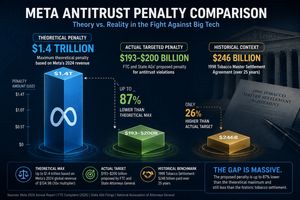 The disparity between theoretical and targeted penalties in the Meta lawsuit, drawing parallels to historical legal precedents.This image is a conceptual visualization of financial figures and should not be taken as exact monetary reporting.
Legal experts note that the court would have wide discretion over the size of any financial penalty, and anything close to $1.4 trillion is considered unlikely [2]. In other cases involving high potential damages for multiple individual offenses, courts have stopped short of imposing the maximum penalties [2]. Therefore, the $1.4 trillion figure, while attention-grabbing, serves primarily as a rhetorical marker. The case could have significant financial consequences for Meta, while changes to how Facebook and Instagram operate could prove equally consequential [2].
| Financial & Legal Dimension | Meta's Defensive Framing | State AG Prosecution Target |
|---|---|---|
| Maximum Claim Ceiling | $1.4 Trillion (Theoretical statutory penalty limit) [2] | $193 Billion – $200 Billion (Targeted civil payout) [1] |
| Historical Comparison | "No analog in consumer protection history" [2] | 1998 Tobacco Master Settlement Agreement ($206 Billion) [7] |
| Primary Remediation | Case dismissal based on broad statutory immunity [9] | Multi-billion payouts paired with forced algorithm redesigns [2] |
| Key Statutory Drivers | COPPA data collection and state unfair trade practice acts [1] | Systematic platform design defects and deceptive safety claims [1] |
According to Eric Goldman, Professor and Co-Director of the High Tech Law Institute at Santa Clara University School of Law, "The state attorneys general are going for the gusto" [2]. This sentiment underscores the aggressive legal posture taken by the states. Conversely, James Grimmelmann, Law Professor at Cornell Law School and Cornell Tech, noted the impracticality of the maximum figure, stating, "An award that large would put Meta into bankruptcy, wipe out its owners, and effectively result in the states owning Meta" [2]. A Meta spokesperson criticized the states' approach, saying, "Rather than sticking to the facts or the law, the states have instead decided to chase an outlandish payout" [1].
Investor's Imperative: Look Beyond the Headlines
Institutional investors and corporate executives should filter out the sensational $1.4 trillion headlines and instead brace for a structured multi-billion-dollar settlement coupled with mandatory product modifications. These changes, such as bans on infinite scroll and stricter age verification, could foreseeably reduce long-term youth user engagement metrics and necessitate shifts in platform monetization strategies.
Why Do State Attorneys General Have More Legal Standing Than Parents to Sue Tech Giants?
The idea that a collective of states can bring a massive lawsuit against a tech giant, while individual parents often struggle, reveals a critical distinction in legal standing. For individual plaintiffs, the source identifies significant procedural and evidentiary challenges, particularly in establishing causation and obtaining systemic remedies [6]. The source does not establish that arbitration clauses or class-action waivers bar private citizens from pursuing mass torts in open court. Instead, it notes that individual plaintiffs typically cannot obtain the systemic remedies available to municipal plaintiffs [6].
State Attorneys General, however, operate under a different legal paradigm altogether. The source instead emphasizes that public entities can pursue claims based on collective and institutional harms, allowing them to seek remedies that individual plaintiffs typically cannot obtain [6]. Public entities can therefore pursue systemic remedies based on collective harms, rather than being limited to the individualized remedies typically available to private plaintiffs. [6].
State prosecutors further bolster their position by utilizing the common law public nuisance doctrine. The source reports that Meta and other social media companies face lawsuits from states, municipalities, school districts, and individuals over allegations that their products harm young users [1]. By asserting direct institutional injury—the burden on public services—states can frame the alleged harms in collective and institutional terms. The source describes the public-nuisance approach as allowing plaintiffs to address harms to public systems rather than focusing solely on individual injuries [6].
Moreover, the states allege that Meta improperly collected and used children’s personal data, adding a federal-law dimension to the case [1]. The lawsuit alleges that Meta routinely collected data on children under 13 without parental consent, despite knowing that children under 13 were using its products [3].
One particularly compelling edge case brought forward by state prosecutors concerns Meta's account handling for underage users. The source reports that Meta had internal procedures for identifying and disabling accounts belonging to children under 13, while prosecutors have alleged that the company nevertheless continued to allow some underage users to access its platforms [3]. This issue forms part of the broader allegations concerning Meta's handling of underage users and their personal data [3]. The discrepancy has become part of the states’ broader scrutiny of Meta’s approach to protecting children on its platforms [3].
State filings also presented evidence concerning Meta’s approach to young users, including internal material discussed in the case regarding the company’s efforts to retain younger users [8]. This material formed part of the broader evidence concerning Meta’s treatment of young users and its platform practices [8]. The research has been cited in the case as evidence of Meta’s focus on retaining young users and maximizing long-term advertising revenue [4].
 Visualizing the 'product liability' framework transforming software features into accountable 'products,' bypassing traditional legal immunities.This image is a conceptual representation of legal frameworks and software design principles.
California attorney Megan O’Neill summarized the prosecution’s position in her opening statement, saying, "Meta's business model can be summed up with four simple words – hook the user, hold them for as long as they can, harvest their data, and then hide the truth" [9]. She further emphasized the shared responsibility for children's health, stating, "I heard from many of you at jury selection that the health and wellbeing of kids is a shared responsibility. Meta didn't do its share" [7]. Echoing this sentiment, Russell Coleman, Attorney General at the State of Kentucky, drew a parallel to past victories: "AGs are in the perfect position to get this done. We did it with the tobacco settlement in the 1990s. We did it with the companies behind the opioid crisis. We’ll do it again with Meta" [7].
Platform Operator's Prudence: Close the Loopholes
Digital product teams within technology companies must undertake rigorous audits of their age verification workflows, specifically eliminating any linked multi-app account loopholes. This proactive measure is essential to prevent strict liability COPPA enforcement actions by increasingly vigilant state regulators and mitigate significant legal and reputational risks.
How Does the "Product Liability" Precedent Bypass Section 230 Immunity?
The legal strategy employed by the state attorneys general in the Meta lawsuit represents a profound turning point in litigation against Big Tech. Since its enactment in 1996, Section 230 of the Communications Decency Act has provided internet platforms with broad immunity from liability arising from content supplied by third parties [5]. This immunity has traditionally covered everything from defamatory posts to user-uploaded videos and comments, allowing platforms to host vast amounts of third-party content without being held liable for its specific illicit elements.
However, state prosecutors are challenging Meta’s reliance on Section 230 by focusing their claims on the design and operation of the platforms rather than solely on third-party content [4]. They contend that features integral to Meta's platforms—such as infinite scroll, variable reward algorithms, continuous push notifications, and automated beauty filters—are not merely vehicles for third-party speech. Instead, they argue that these features were defectively designed and contributed to the alleged harms to young users [4].
This legal strategy draws heavily on the Ninth Circuit precedent established in Lemmon v. Snap, Inc. [5]. In Lemmon, the Ninth Circuit considered whether Section 230 immunized Snap from liability for claims arising from the design of Snapchat’s Speed Filter, which allegedly encouraged users to drive at dangerous speeds. The court concluded that Section 230 did not bar those product-liability claims [5]. The crucial distinction made was that the duty to design a safe product emanates from the company's role as a manufacturer, entirely separate from its role as a publisher of third-party speech [5].
Presiding U.S. District Judge Yvonne Gonzalez Rogers applied this distinction in the multidistrict litigation against Meta, examining the alleged functionality defects in the platforms and determining which claims could proceed despite defendants’ Section 230 arguments [10]. The case focuses on claims that Meta’s products themselves were engineered in ways that allegedly caused harm, rather than claims based solely on content posted by users [4]. The court’s approach therefore illustrates how claims concerning alleged defects in platform functionality can be analyzed separately from claims that seek to hold a platform liable as a publisher or speaker of third-party content [10].
| Legal Framework | Scope of Protection | Case Precedent Impact |
|---|---|---|
| Traditional Section 230 Defense | Immunizes platforms hosting or moderating third-party user content [5] | Applies to defamatory posts, user video uploads, and user comments [5] |
| Product Liability Framework | Holds developers accountable for defective software architecture and design choices [5] | Overcomes immunity for auto-play, continuous feeds, and engagement triggers [5] |
This legal development could have implications beyond the specific platform features at issue, as the distinction between product-design claims and claims involving third-party content may be relevant to other digital services [5]. If platform architecture and its embedded engagement mechanisms are definitively recognized as manufactured products subject to defect torts, the implications are potentially broader. If courts extend this product-liability approach to other forms of digital platform architecture and engagement mechanisms, similar questions could arise for technologies such as recommendation systems and other automated features [5]. This could narrow the circumstances in which Section 230 immunity applies when claims concern the design and operation of digital platforms rather than third-party content [5].
During the trial, the states were expected to present testimony from former Meta employees and experts, along with internal documents and research concerning the company’s products and their effects on young users [1]. Whistleblower Arturo Béjar, a former Engineering Director at Meta, described how engineering recommendations aimed at suppressing content related to eating disorders and self-harm were significantly diluted before their implementation. "But once it was reviewed, it got whittled down to a little pebble that didn't make a difference," Béjar stated, describing how the recommendations were reduced during the review process [3].
Meta's legal defense, conversely, denies the allegations and argues that government lawyers have taken internal documents and emails out of context, while noting that the company has studied young users to consider how it could support teens on its platforms [7]. Meta cited internal data showing that between 2020 and 2024, it disabled nearly 1.5 million accounts believed to be used by children under 13 [8]. Paul Schmidt, an attorney for Meta, argued, "Much of this lawsuit is about the government attorneys and their witnesses saying in trying to improve, we'd do it a little differently," emphasizing the differences in how the platforms could be improved [3].
Technology Developer's Mandate: Design for Safety, Document for Defense
Software engineering organizations must embed rigorous product liability risk assessments directly into their user interface design and development lifecycles. It is no longer sufficient to merely build; companies must meticulously document safety considerations, mitigation strategies, and user impact analyses for all engagement-maximizing features to preempt future legal challenges.
Implications: A Seismic Shift for Big Tech
The Meta lawsuit, regardless of its ultimate financial outcome, signals a seismic shift in the legal and regulatory landscape for Big Tech. The pursuit of multi-billion-dollar liabilities, though less than the theoretical $1.4 trillion, is still substantial enough to necessitate significant reevaluation of corporate strategies and resource allocation. The case could also lead to significant changes in how Facebook and Instagram operate, with the states seeking extensive financial damages and potentially extraordinary structural remedies if they succeed [4].
This case is effectively a legal stress test for the entire digital economy's reliance on engagement-maximizing designs. If algorithmic features are indeed classified as products subject to defect liability, this precedent could open the floodgates for similar lawsuits targeting other platforms and technologies. We might see future litigation challenging the addictive nature of online gaming mechanics, the curated feeds of news aggregators, or even the persuasive architectures of e-commerce sites. The regulatory scrutiny is not confined to social media; it extends to any digital service that employs algorithms to shape user behavior and engagement. This shift demands a proactive re-evaluation of ethical design principles and a fundamental recalibration of the balance between user engagement and user well-being.
The implications for data privacy, particularly concerning minors, are also profound. The source reports allegations concerning Meta’s handling of accounts belonging to users under 13, including claims that the company continued to allow some underage users to access its platforms [3]. These allegations form part of the broader dispute over Meta’s collection and handling of children’s personal data. This could increase scrutiny of how Meta manages underage accounts and personal data across its platforms.
Ultimately, this lawsuit is a harbinger of a new era of digital accountability. It underscores a growing societal demand for technology companies to prioritize user safety and well-being over unchecked growth and engagement metrics. The era of platforms enjoying near-absolute immunity for the societal impacts of their design choices appears to be drawing to a close. While the tech industry has historically driven innovation at a breakneck pace, this legal challenge forces a crucial pause, compelling a more reflective and responsible approach to the creation and deployment of digital experiences, particularly those aimed at vulnerable populations like children.
Future-Proofing for Tech Leaders: Embrace Ethical Design Now
Technology leaders must proactively embed ethical design principles and robust user safety measures into the core of their product development. Moving forward, a competitive edge will hinge not just on innovative features, but on demonstrating unwavering commitment to user well-being, transparent data practices, and comprehensive regulatory compliance across all platforms.
Technology Lawsuit Insights: Frequently Asked Questions About the Meta Trial
Who sued Meta for $1.4 trillion in California federal court?
Is Meta actually going to pay $1.4 trillion in fines?
Why do state Attorneys General have standing to sue Meta when parents face arbitration?
How do prosecutors bypass Section 230 immunity in the Meta trial?
What cross-platform loophole did state prosecutors expose during trial discovery?
Disclaimer: This article discusses technology-related subjects for general informational purposes only. Data, insights, or figures presented may be incomplete or subject to error. Images and diagrams are for illustrative purposes only and may not represent exact products, interfaces, or official designs. For further information, please consult our full disclaimer.