Air Travel Safety: Why Space Junk Is the Newest Threat in 2026 | We Need to Talk! 🚨
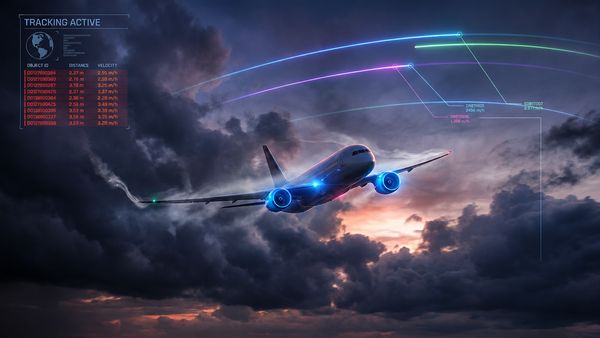 Navigating the New Normal: Commercial airliners face unprecedented threats from descending space debris.This image is a conceptual representation of the challenges faced by commercial airliners due to descending space debris and is not an actual event.
Here’s what’s blowing up my feed, and honestly, it should be blowing up yours too: space junk. We're talking about a lurking threat that's about to redefine air travel safety in 2026, and it’s giving major 'main character in a disaster movie' energy. Remember when we thought turbulence was the main drama? Honey, that was just the warm-up act. The real Canon Event for our skies is already unfolding, and it’s coming from above.
It sounds like sci-fi, right? But trust me, this isn't some niche conspiracy theory for space nerds. The rapid growth in the number of space objects is flipping the script on how aviation has to think about uncontrolled reentries, with future megaconstellations expected to increase reentry-related risks [1]. While we used to worry about debris hitting satellites up there, the real tea is that defunct spacecraft, random fragments, and discarded rocket stages are now doing a literal nose-dive, heading straight for civil aviation. This isn't just a 'what if' scenario; it's a real-time, escalating challenge for civil aviation authorities, air navigation service providers, and airlines alike. The physical safety hazards, airspace management disruptions, and straight-up legal ambiguities are reaching peak levels, and honestly, the vibe check is mandatory! 🚨
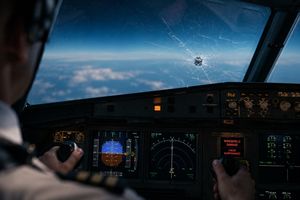 Even a tiny fragment can cause major operational hazards, turning a smooth flight into an emergency.This image is a conceptual representation of the impact of space debris on a cockpit windshield and is not an actual event.
How Descending Space Debris Becomes a Kinetic Threat to Commercial Aviation 💀
Okay, let’s get into the nitty-gritty of why this isn't just a bad dream. The physical threat posed by space debris plummeting towards commercial aircraft is all about extreme kinetic energy transfer during a collision [1]. Think about it: commercial jets are cruising at altitudes between 30,000 and 42,000 feet, chilling at Mach 0.78 to Mach 0.85 – that's roughly 230 to 250 meters per second. Now, imagine a piece of space junk, from an entire rocket stage to a tiny structural fragment, entering the lower atmosphere. Even with atmospheric drag doing its best to slow things down, the sheer relative velocity during an impact creates destructive force that’s, well, catastrophic. The speed of the aircraft itself massively contributes to the total kinetic energy of the collision [1]. It’s a literal recipe for disaster, and it's less 'oops' and more 'oh no, the end credits are rolling.'
This isn’t just theoretical; peer-reviewed impact modeling proves that even tiny space debris fragments, as small as 1 gram, pose an acute operational hazard [1]. A gram! That’s like, a paperclip. These tiny terrors can shatter multi-layered cockpit windshields, mess up flight control surfaces, or cause severe ingestion damage if they get sucked into those massive turbofan engines [1]. And get this: experimental ballistics testing has shown that 9-gram steel fragments can cleanly perforate standard aluminum aircraft skin panels and even those super-modern carbon-composite fuselage structures [1]. But the real gut punch? Fragments weighing over 300 grams (about two-thirds of a pound) carry enough kinetic energy to cause catastrophic destruction of primary load-bearing structures, leading to total airframe breakup in flight [1]. As Professor Aaron Boley at the University of British Columbia put it, "Research shows that as little as 300 grams of debris — or two-thirds of a pound — 'could catastrophically destroy an aircraft'" [8]. It’s a genuine ‘Game Over’ moment.
We’ve even got some vintage tea on this, if you can believe it. Historical aviation records are confirming that high-altitude collisions with solid objects aren't just a new thing—they’re verified operational edge cases in air safety governance [1]. Back in 1996, a Chinese Boeing 757, with 200 passengers onboard, had its cockpit window severely cracked by an unidentified high-altitude object at 9,600 meters (about 31,500 feet), forcing an emergency landing [7]. Fast forward to March 2007, an Airbus A340 with 270 passengers experienced a terrifying swerve after the flight crew saw burning debris—from a Russian Progress 23P cargo vessel, no less—pass within 8 kilometers of the aircraft, hearing an audible sonic boom [7]. But perhaps the most stark example was the Space Shuttle Columbia breakup in February 2003, which shed thermal tiles and metallic components across active civil flight corridors over Texas and Louisiana for a nail-biting 40 minutes. A subsequent FAA analysis found that the highest conditional probability of impact to any individual aircraft ranged from 1 in 1,000 to 1 in 100, depending on how many debris fragments survived to aircraft altitudes but were never recovered [14]. This isn’t a drill, people; this is a history lesson we can’t afford to forget.
Optimize Flight Dispatch Tactics:
Airline flight operations departments need to integrate dynamic space situational awareness tracking feeds directly into flight dispatch management systems. This ensures flight crews get immediate tactical alerts when they're operating anywhere near predicted atmospheric reentry tracks. No more guessing games; it's about real-time protection.The Probabilistic Risk Model: Are We Living in a Sky Roulette? 🎲
So, what are the odds? Evaluating the probability of a space debris strike on a commercial airliner isn't as simple as flipping a coin; it requires complex, multi-variable modeling that factors in orbital inclinations, atmospheric drag decay rates, fragmentation mechanics, and even aircraft density distributions [1]. While the global baseline probability of a specific aircraft getting hit on any single flight is still low (thank goodness!), the aggregate risk across global civil aviation operations is spiraling upwards faster than a viral dance challenge as launch cadence keeps increasing [1]. It’s like a silent, slow-motion increase in cosmic ping-pong balls aimed at our flight paths.
Mathematical risk models are showing that the global annual collision probability between reentering rocket bodies and commercial aircraft is definitely on an upward trend [1]. The Aerospace Corporation, which knows a thing or two about space, conducted comprehensive risk assessments and evaluated the annual probability of a fatal aircraft collision with reentry debris in 2021 [1]. And here’s the kicker: when you account for the planned deployment and routine replenishment of those 12 major satellite megaconstellations (you know, the ones promising global internet? 🔥), this annual collision probability is projected to increase to 0.07% by 2035 [1]. That might sound small, but for something that could lead to catastrophic failure, it’s a terrifying increment. Correspondingly, the annual risk of one or more global aviation casualties resulting from debris-aircraft collisions is predicted to rise from 0.1% to 0.84% over the same timeframe [1]. It’s a stark reminder that even seemingly low probabilities can become critical when lives are on the line.
Here’s an edge case that’s often missed: the geographical distribution of this reentry risk isn’t uniform; it’s heavily influenced by orbital mechanics [4]. The orbital inclination of a satellite or upper stage dictates its northern and southern latitude limits for atmospheric decay [4]. So, an object in a polar orbit has an equal chance of reentering anywhere, but objects with lower inclinations are concentrated in specific bands [4]. This creates a latitude-dependent reentry probability distribution, with atmospheric reentries concentrated within the northern and southern latitude limits set by the object's orbital inclination [4]. What’s the tea on this? Instead of being spread evenly around the world, the geographic distribution of reentry risk follows the latitude limits set by an object's orbital inclination [4]. Talk about a bad combo. Marlon Sorge, Principal Engineer at The Aerospace Corporation, joked about watching a reentry from his house, saying, "The statistical risk to any one person of being struck by falling space debris is so low that a colleague of mine jokes that if reentry predictions put his house directly under the path, he'd go out with a camera and watch" [9]. While the individual risk might feel low, the aggregate risk to critical infrastructure like air travel is very real.
Academic modeling confirms that high-density airspaces around major international airport hubs face an annual reentry exposure probability of 0.5% to 0.8% [1]. But for expansive regional flight corridors—like the Northeastern United States, Northern Europe, and those massive Asia-Pacific metroplexes—the annual probability of an uncontrolled space object tearing through civil airspace skyrockets to between 14% and 40%, with localized corridor averages around 26% [1]. This crazy high cumulative exposure rate forces aviation authorities into some seriously tough operational decisions, like preemptive airspace closures. It's not just an inconvenience; it's a critical safety conundrum.
Implement Smart Airspace Management:
Air Navigation Service Providers should pivot from broad, blanket regional airspace closures to sophisticated probabilistic risk-based hazard corridors. This approach minimizes flight disruptions while ensuring casualty expectations remain well below established international aviation safety thresholds, keeping us all safer without grounding entire regions.The Economic Externalities: Who's Paying for This Space Mess? 💸
The operational challenges brought on by space junk aren't just about things going boom in the night; they extend way beyond direct physical collision risks, morphing into substantial, uncompensated financial burdens that airline operators are forced to absorb [1]. When a space object decides to make an uncontrolled atmospheric reentry, tracking networks can't precisely pinpoint the exact geographical location and time of its atmospheric decay until literally minutes before it happens [9]. To keep us all safe and uphold aviation safety mandates, national civil aviation authorities have no choice but to issue emergency Notices to Air Missions (NOTAMs) or order precautionary airspace closures that cover thousands of square miles of active flight corridors [1]. It's a real-world 'pause button' on our skies, and it's costly AF.
These preemptive airspace shutdowns are a major headache. They force commercial aircraft into airborne holding patterns (think of your flight doing endless loops), require tactical flight diversions to alternative airports, or trigger extensive ground delays [1]. Case in point: in November 2022, the uncontrolled reentry of a 20-tonne Long March 5B rocket core stage literally made European air traffic management authorities shut down huge sections of Spanish, French, and Italian airspace for several hours [1]. That single event disrupted hundreds of commercial flights, leading to delays, rerouting, and additional operational costs that were largely borne by the affected airlines [1]. That’s a lot of lost revenue that literally evaporated into the atmosphere, all thanks to someone else's space junk.
Here’s the hidden truth, a real industry secret if you will: from an economic standpoint, the commercial space sector is essentially exporting negative operational externalities directly onto the civil aviation industry [1]. Launch providers and satellite operators are cutting mission costs by skipping dedicated retro-propulsive de-orbit hardware or skimping on propellant reserves [1]. Meanwhile, commercial airlines, air cargo operators, and us, the traveling passengers, are left holding the financial bag for the resulting airspace closures [1]. We’re talking: increased jet fuel burn and expanded carbon compliance liabilities; aircraft and crew displacement leading to missed connections and compensation; and under statutory regimes like EU261, airlines absorbing direct financial liability for passenger delays, hotels, and rebooking costs [1]. It's a structural challenge that the International Air Transport Association (IATA) continues to highlight, emphasizing the importance of proactive safety management, industry collaboration, and data-driven risk management to address emerging operational risks across aviation [2].
Advocate for Cost-Recovery Frameworks:
Aviation industry associations absolutely must lobby international transport regulators for robust cost-recovery frameworks. These frameworks should mandate that commercial launch providers reimburse airlines for all verifiable fuel and operational expenses directly caused by precautionary airspace closures. It’s time for accountability in orbit. The complex dance of orbital decay and flight paths creates critical zones of probabilistic risk.This image is a conceptual representation of orbital reentry paths and flight corridors, illustrating potential risk areas.
The Legal and Regulatory Battleground: Who Owns the Sky? ⚖️
Governing the intersection of space operations and commercial aviation safety is a whole vibe shift in itself, requiring close coordination between the aviation and space sectors as higher airspace operations continue to evolve [3]. On one side, we have civil aviation safety, globally governed by the 1944 Chicago Convention and overseen by ICAO [10]. Article 1 of this convention basically says every sovereign state has complete and exclusive sovereignty over the airspace above its territory [10]. National Aviation Authorities then flex their regulatory muscles within their sovereign airspace, applying risk- and performance-based approaches to establish the safety, security, contingency, and resilience requirements needed for higher airspace operations [3]. It’s all about protecting what’s ours below.
Then, we swing over to space activities, which are governed by the 1967 Outer Space Treaty and the 1972 Space Liability Convention [5]. Article II of the Liability Convention is a game-changer, establishing that a launching state is absolutely liable to pay compensation for damage caused by its space object to civil aircraft in flight or on the surface of the Earth [5]. So, if space junk hits your plane, the launching state is financially liable, no questions asked, regardless of negligence [5]. Seems straightforward, right? Not so fast, my friends. This is where the legal system gets a bit… messy.
The truth is, international space law has some serious legal gaps, especially when it comes to operational safety and economic disruption [1]. This is an edge case that needs to be addressed ASAP. For one, the Liability Convention only compensates states for direct physical damage to property or loss of life [5]. It offers zero legal mechanism to recover those crushing indirect economic losses from precautionary airspace closures [1]. So, airlines are left holding the bill for delays and diversions, even if it’s a direct consequence of space activity. Then there’s the regulatory vacuum in Higher Airspace—that undefined region between controlled civil airspace (above 60,000 feet) and Low Earth Orbit (below 100 kilometers) [3]. This means Higher Airspace Operations (HAO), including suborbital transits, hypersonic vehicles, and orbital reentries, are basically operating in a regulatory grey area [3]. It’s giving Wild West vibes, but in the sky. And let’s not even get started on outdated post-mission disposal timelines, which used to permit satellites and rocket stages to stay in orbit for up to 25 years after their mission [5]. Given current launch volumes, that's just not going to cut it for preventing orbital crowding and those pesky uncontrolled atmospheric decays [5].
But there’s a flicker of hope! Regulatory authorities are finally stepping up to establish stricter mitigation requirements [6]. The European Space Agency, for instance, has adopted its Zero Debris approach, updating its Space Debris Mitigation Policy and Administrative Instruction, introducing more stringent disposal requirements—including shorter disposal timelines—and promoting the Zero Debris Charter to advance debris mitigation across the global space sector by 2030 [6]. Josef Aschbacher, Director General at the European Space Agency, put it perfectly: "Space activity is fundamental to taking care of our people and our planet, and in return, we must be responsible in how we behave in space. ESA is aiming at zero debris by 2030" [12]. This is a huge, positive vibe shift towards responsible space behavior. Simultaneously, civil aviation authorities are pushing for integrated regulatory oversight [3]. EASA’s Higher Airspace Operations Task Force is actively working to establish unified safety methodologies to govern space vehicles as they transit civil airspace during launch and reentry phases [3]. It’s a collective glow-up for our skies!
Mandate Controlled De-Orbit Maneuvers:
National space licensing agencies need to amend commercial launch permits to demand mandatory, controlled retro-propulsive de-orbit maneuvers for all upper rocket stages. License approval should be conditional on explicitly protecting civil airspace. This isn't optional; it's non-negotiable for future air travel safety.Tech & Traffic Management: The Future of Sky Safety 🚀
Mitigating the atmospheric reentry hazard for civil aviation isn't some magic trick; it demands the seamless integration of Space Situational Awareness (SSA) tracking assets with Air Traffic Management (ATM) systems [11]. We have ground-based tracking assets, such as the U.S. Space Force's Space Fence radar system, that detect, track, and catalog objects in Earth orbit, providing critical data for space situational awareness. [17]. But here's the plot twist: predicting the exact reentry trajectory of an unpowered space object remains a super challenging task, mainly because of unpredictable upper-atmospheric drag fluctuations, which are literally driven by variable solar activity and geomagnetic storms [9]. It’s like trying to predict a meme's virality—you can try, but the internet has its own plans.
To level up aviation safety, aerospace researchers and air navigation authorities are seriously cooking up some advanced technical and procedural solutions [5]. One major player? Integrated Space Traffic Management (STM) Platforms. Across Europe and North America, the focus is on directly linking orbital surveillance databases with air traffic control automation systems [13]. Imagine: modern algorithms ingesting orbital decay telemetry to model dynamic, three-dimensional hazard zones [11]. These systems would let controllers route aircraft around localized high-risk footprints without having to shut down massive regional flight corridors [1]. It's about precision over panic. Another key move is mandatory active tracking hardware. Regulatory bodies are looking at requiring active tracking devices—like independent satellite GPS transponders, optical beacons, or passive radar retroreflectors—on all upper stages and satellite buses [5]. Active tracking devices can supplement orbital surveillance data with additional telemetry, helping improve awareness of a space object's position and supporting reentry monitoring efforts [5]. It’s a game-changer for knowing exactly where the debris is headed.
But the real glow-up for heavy space structures? Controlled reentry offers the most effective technical approach to reducing aircraft impact risk [4]. Targeted retro-propulsive de-orbiting is the most effective technical solution. This means guiding upper stages to remote ocean disposal areas—like the South Pacific Ocean Uninhabited Area (SPOUA)—where they can safely complete controlled reentry over an uninhabited region [9]. Giovanni Di Antonio, Chair of the EASA Higher Airspace Operations Task Force, perfectly encapsulated the goal: "Ensuring the safe and orderly implementation of higher airspace operations using risk- and performance-based approaches to innovation and regulation when establishing the appropriate requirements for safety, security, contingency and resilience of operations" [3]. This is about building a path forward, not just reacting to chaos. Here’s a tough truth, though: over 2,300 rocket bodies are already in orbit and will eventually reenter Earth's atmosphere in an uncontrolled manner, meaning aviation authorities will face these reentry hazards for decades to come [15]. Because active debris removal (ADR) is still in the developmental and demonstration stages, aviation authorities are expected to continue managing the risks posed by uncontrolled reentries for the foreseeable future [16]. It's a long-term commitment to keeping our skies clear.
Automate Air Traffic Control Safety:
Air traffic management authorities must deploy automated risk-barrier software that ingests real-time orbital tracking telemetry. This will empower air traffic controllers to issue precise vectoring instructions to flight crews during unexpected atmospheric decay events, transforming reactive responses into proactive safety measures.Strategic Imperatives: Securing Our Skies for the Future 🌟
Addressing the ever-growing operational challenge of space debris in commercial flight corridors isn't a solo mission; it demands structured collaboration between the civil aviation and commercial space sectors [1]. As satellite deployments and launch frequencies continue to scale globally, managing atmospheric reentry risks means we have to evolve. We need to transition from simply reacting with airspace closures to proactive, fully integrated safety frameworks [1]. This is about shifting our entire Aura, from reactive to visionary.
To protect global air traffic while simultaneously supporting sustainable space operations (because we need both!), international stakeholders absolutely must prioritize three strategic imperatives. First, we need to mandate controlled reentry standards. International regulatory bodies should require controlled reentries for future missions whenever technically feasible, directing large space objects into designated remote oceanic disposal areas to minimize aircraft impact risk [4]. No more 'hope for the best' scenarios. Second, we need to harmonize legal and economic liability. The current legal framework leaves airlines bearing the operational costs of precautionary airspace closures, highlighting the need for international stakeholders to address how responsibility and liability are allocated [1]. It's only fair. And finally, we absolutely need to deploy unified STM-ATM data networks. Civil aviation authorities must integrate orbital telemetry streams directly into air traffic control platforms, enabling dynamic hazard zoning that keeps us safe while minimizing air traffic disruption [11]. Implementing these measures isn't just about avoiding a catastrophe; it’s about safeguarding commercial air travel and ensuring that Earth’s flight corridors remain protected amid the ongoing, breathtaking growth of global space operations [1]. Let’s make 2026 the year we secured our skies, for real. 🔥
Trending Now: Your Top Questions on Air Travel Safety Answered
What is the statistical probability of space debris striking a commercial aircraft?
Can a small piece of space junk destroy a commercial airplane?
How do air traffic authorities handle uncontrolled space debris reentries?
Who pays for airline costs caused by space debris flight diversions?
How many legacy rocket stages currently present an uncontrolled reentry hazard?
Disclaimer: This article addresses trending topics and current events for general informational purposes only. The content may reflect public interest or opinion and has not necessarily been independently verified. Images and visuals are illustrative and may not depict real or official events. For complete details, please review our full disclaimer.