Human vs. AI Music: Can Soulful Notes Survive the Algorithm?
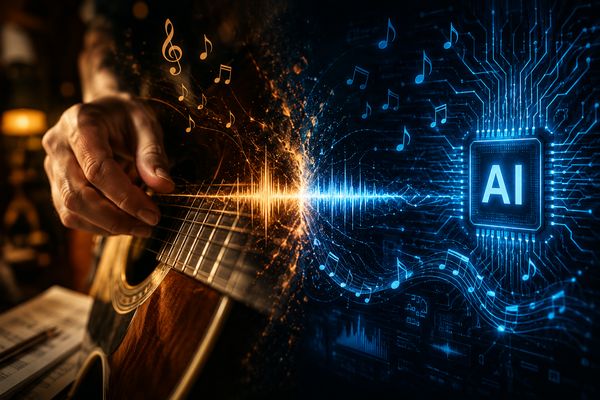 The delicate balance: human emotion meets algorithmic precision in the future of music.The image above is a visual representation and not a direct depiction of any specific event or product.
Imagine a lone producer, hunched in the dim glow of his studio monitors. His fingers dance across the keyboard, not composing notes, but crafting prompts – a lyrical command here, a harmonic parameter there. With a final flourish, he renders a pop anthem. It’s an AI-generated recording, raising questions about whether wholly AI-generated music should qualify for official charts [1]. Millions of streams overnight. The charts? Conquered. But is it truly music?
This isn't a dystopian fantasy; it's the very real, visceral challenge facing the global music industry today. We've reached a structural turning point, a seismic shift where the very definition of artistry is being re-evaluated in real time. The question isn't just if AI can make music, but if the soulful, indefinable essence that makes us connect with a melody can survive the relentless march of the algorithm.
How Will Australia’s ARIA Chart Ban Redefine Global Music Standards?
The Australian Recording Industry Association (ARIA) didn't just tweak a few lines in a dusty rulebook; they dropped a bombshell. Effective August 31, 2026, wholly AI-generated tracks are officially barred from its charts and awards. Their decree is unequivocal: releases must be 'substantially human-made' [1]. This isn't just about Australia; it’s a bellwether, a clear signal echoing across international waters, showing where the industry's compass is now pointing. In Australia, the policy change followed scrutiny surrounding Josh Fawaz's AI-assisted cover of Madonna's “Like a Prayer,” which had climbed the Australian charts [2].
The immediate catalyst? Australian producer DJ Josh Fawaz and his AI-assisted cover of Madonna’s 'Like a Prayer.' The recording accumulated more than 48 million Spotify streams, reached the top of the ARIA Australian Dance Singles chart, and peaked at Number 2 on the Australian Singles chart [1]. Fawaz, after intense industry scrutiny, only later disclosed the use of generative AI vocal and drum models. The disclosure came amid scrutiny over the use of generative AI in music and contributed to discussions about how such recordings should be treated under chart eligibility rules [1].
Under ARIA's updated rules, the essence of eligibility lies in human endeavor. For a recording developed using generative AI to qualify, the human creators must have written the song and performed the lead vocal and primary instruments [1]. Crucially, though, this isn’t a wholesale rejection of technology: certain AI-assisted production tools, including AI mastering, stem separation, AI drum machines, and AI effects, may be used while the recording remains eligible under the rules [1]. The updated rules reflect global principles developed by the International Federation of the Phonographic Industry (IFPI), which ARIA says were published on July 30, 2026 [1].
Annabelle Herd, CEO at the Australian Recording Industry Association, articulated the core dilemma: "Artists already use AI tools in their work; the charts can and should evolve to keep room for that, but music generated wholesale by services built on artists' recordings is a different matter" [1]. She also warned that rewarding unlicensed AI output on the charts could undercut the basis of the recorded music industry: "A chart that rewards unlicensed AI output would undercut the very basis of the recorded music we exist to represent" [6]. It's a stark reminder that this isn't just about art; it's about livelihoods, intellectual property, and the foundational economics of an entire industry.
One fascinating edge case within ARIA's updated code is its enforcement mechanism: rather than using automated scanning technology, ARIA says enforcement relies on the global labelling standard, disclosure by artists and labels, and the association's own discretion [2]. However, ARIA may retrospectively remove an ineligible recording from the charts, amend chart positions, revoke an accreditation, and revoke an award, including requesting the return of a physical award [1]. Imagine the shock, the controversy, as past glories are re-evaluated, potentially altering the very fabric of music history. It's a digital Sword of Damocles hanging over every past and future chart-topper.
| Scenario ARIA Chart Status | Core Eligibility Requirements |
|---|---|
| Wholly AI-Generated Recording | Ineligible. Zero human performance or authorship; generated via text prompt [2]. |
| Human Song with AI Voice Clones | Ineligible. Lead vocal performed by AI model without human audio capture [1]. |
| Human Performance with AI Supporting Tools | Eligible. Humans write song, sing lead vocal, and play primary instruments; AI used in mastering [1]. |
| Tracks Built on Unlicensed AI Training Data | Ineligible. Violates IFPI principles regarding authorized technology use [2]. |
| Manipulated or Botted AI Streams | Ineligible. Triggers automatic fraud disqualification [1]. |
Document Your Creative Journey:
Independent artists and recording labels leveraging generative software must diligently preserve detailed production logs. This includes raw multitrack session files, unedited vocal takes, and MIDI stems. Keeping these records can help document how the recording was produced and demonstrate the role of human creators in the work [1].
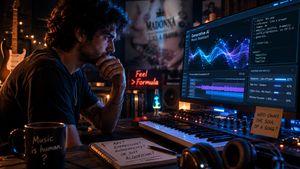 The modern studio: where human intent guides the algorithmic muse, navigating new ethical landscapes.The image above is a visual representation and not a direct depiction of any specific event or product.
How Are Copyright Lawsuits and Regulatory Frameworks Drawing the Line Between Human and Synthetic Creation?
The legal dispute surrounding generative music centers on allegations that AI music services copied copyrighted sound recordings to train their models, raising questions about ownership, compensation, and creative rights [8]. It’s not just about a song; it’s about ownership, fair compensation, and the future of creative rights.
In June 2024, the Recording Industry Association of America (RIAA), the powerhouse representing Universal Music Group, Sony Music Entertainment, and Warner Music Group, launched a legal offensive. They filed massive federal lawsuits against AI music platforms Suno and Udio [9]. The allegations center on claims that the platforms copied large quantities of copyrighted sound recordings and used those copies to train their generative AI models [8]. The stakes are significant, with potential damages of up to $150,000 per infringed track, while Suno and Udio argue that their use of copyrighted music is protected by “fair use” [9].
Mitch Glazier, Chairman and CEO at RIAA, didn’t hold back: "Unlicensed services like Suno and Udio that claim it's 'fair' to copy an artist's life's work and exploit it for their own profit without consent or pay set back the promise of genuinely innovative AI for us all" [8]. This isn't just legal rhetoric; it's a declaration of war on what the industry perceives as predatory practices. It's a clash of titans, with the legacy music industry fighting to protect its very foundations against a new, disruptive force.
Concurrently, courts and the U.S. Copyright Office are addressing how existing copyright law applies to works created with artificial intelligence [10]. The U.S. Copyright Office has stated that works created entirely by AI without human authorship are not eligible for copyright protection [10]. Simply entering text prompts into a generative model, they argue, does not satisfy the human authorship threshold [11]. For music containing AI-created elements, the Recording Academy says that the work may be eligible for GRAMMY consideration when the relevant human creative contributions meet the requirements for the category [12]. This distinction is crucial; it means a human must be demonstrably in the driver's seat, not just nudging an AI from the back seat.
The Recording Academy, the organization behind the GRAMMY Awards, has clarified that music containing AI-created elements can be submitted for consideration, but the AI-generated portion itself cannot receive a GRAMMY nomination or award [12]. While music containing synthetic elements can be submitted, the human creative contribution must be meaningful, with the Academy stating that a human must contribute “in a more than de minimis amount” to be considered for a nomination or win [12]. This creates fascinating, sometimes awkward, scenarios. For instance, if a human writes a track and an AI voice model sings the lead vocal, the track might compete in songwriting categories, but it would be disqualified from performance categories [12]. "Only human creators are eligible to be submitted for consideration for, nominated for, or win a GRAMMY Award," declared Harvey Mason Jr., CEO at the Recording Academy [12]. It’s a clear demarcation line drawn in the sand of artistic recognition.
On the corporate rights management front, Universal Music Group has been working with digital service providers on an “artist-centric” approach, while emphasizing protections around artists’ voices, music, and the use of their works in generative AI [5]. Universal Music Group, for example, has been working with digital service providers on an “artist-centric” approach, including efforts to ensure that artists are appropriately rewarded and that their music is protected in the evolving streaming and AI landscape [5]. Sir Lucian Grainge, Chairman and CEO at Universal Music Group, stated unequivocally: "WE WILL NOT LICENSE ANY MODEL THAT USES AN ARTIST'S VOICE OR GENERATES NEW SONGS WHICH INCORPORATE AN ARTIST'S EXISTING SONGS WITHOUT THEIR CONSENT" [13]. This is a powerful stance, signaling that the industry's titans are prepared to use their considerable influence to control how their valuable assets are used, or rather, not used, by generative AI.
| Copyright & Legal Stage | Primary Assessment Criteria | Legal & Commercial Outcome |
|---|---|---|
| Training Data Ingestion | Was original human recording scraped without license? | Subject to RIAA statutory damages up to $150k/track [8]. |
| Human Authorship Threshold | Is human input prompt-only or substantial composition? | Prompt-only outputs placed into public domain [10]. |
| Award Eligibility Evaluation | Is human contribution meaningful and non-de minimis? | Only human component eligible for GRAMMY recognition [12]. |
| Chart Qualification Check | Are lead vocals & core instruments human-performed? | Substantially human tracks admitted to official rankings [1]. |
Ensure Licensed Datasets and Document Composition:
Enterprise music producers must verify that all third-party software integrated into their recording chain exclusively utilizes opt-in, fully licensed datasets. The source emphasizes that human authorship is important for copyright protection, noting that music generated entirely by AI cannot receive copyright protection under the U.S. position described [9].
 Defining the lines: legal frameworks attempt to separate human IP from AI-generated content.The image above is a visual representation and not a direct depiction of any specific event or product.
How Do Streaming Platforms Plan to Crate-Dig Through Algorithmically Flooded Catalogs?
The sheer, unfathomable volume of music being uploaded to commercial streaming networks has spiraled into an administrative crisis. A recent study by music submission platform SubmitHub, using its SH Labs detection engine, analyzed over a million tracks and found that nearly 40% of new music released worldwide in July 2026 involved AI tools [3]. To break that down further: 23.2% of the surveyed tracks were entirely AI-generated, while another 15.3% featured synthetic audio heavily modified by humans [3]. The future isn't just coming; it's already here, with algorithmic compositions becoming an increasingly visible part of the music landscape.
As AI-generated music becomes more prevalent, streaming platforms are introducing measures to identify and manage synthetic content [3]. Spotify CEO Daniel Ek outlined three distinct categories, or “buckets,” for AI use in music [15]:
- Enhancement Tools: Software like Auto-Tune or automated mixing assistants, which refine human execution, are fully supported. The source says that tools such as auto-tune can enhance the quality of music, helping artists refine their work and benefiting the industry and listeners [15].
- Unauthorized Impersonation: Vocal cloning models that mimic real artists without consent? Spotify stands firmly against this practice, emphasizing the importance of respecting artists’ creative expressions [15].
- Synthetic Original Content: This is the complex middle ground. AI-generated music may be influenced by existing artists without directly impersonating them, blurring the line between imitation and originality [15].
To help listeners identify AI-generated artists, Spotify plans to add an “AI Persona” badge to certain artist profiles starting in September [3]. The source cites “The Velvet Sundown” as an example of a synthetic music project whose Spotify profile was revised after Reddit users questioned the authenticity of the band [3]. But here's the kicker, the algorithmic twist: Spotify says AI Personas will be omitted from its editorial and algorithmic recommendations, with the aim of increasing visibility for music created by human artists [3]. It’s a digital exile, isolating synthetic content from the organic, human feeds that drive mainstream discovery. This is a crucial edge case: being on the platform isn't enough; being discoverable on the platform is the real battle.
Watermarking is another component of the broader effort to identify AI-generated content [16]. Google DeepMind’s SynthID is described by the source as an invisible watermark embedded in AI-generated images, providing compatible detection systems with an additional signal for assessing whether content came from a supported AI system [16]. The watermark is designed to remain imperceptible to people viewing the image while surviving ordinary changes, although repeated or disruptive processing can make it harder to detect [16]. A failed verification does not necessarily prove that every trace of the watermark has been removed; the source distinguishes between a detector failing to find a watermark, degradation of the watermark signal, and complete removal [16]. The broader takeaway is that invisible watermarks can provide a useful provenance signal, but the source recommends treating them as only one part of a stronger, layered provenance system [16].
Alexis Lanternier, CEO at Deezer, captured the nuanced stance of many platforms: "AI is not inherently good or bad, but we believe a responsible and transparent approach is key to building trust with our users and the music industry" [14]. This sentiment underscores the delicate balance platforms must strike between embracing innovation and protecting the integrity of their content libraries and the artists who fuel them.
| Platform / Body | Curation Policy | Identification Mechanism | Algorithmic Impact |
|---|---|---|---|
| Spotify | Permits AI assistance; isolates synthetic artists via "AI Persona" badges [3]. | Metadata self-disclosure & spectral analysis scanning [3]. | AI Personas excluded from Discover Weekly & editorial playlists [3]. |
| Deezer | Tags albums containing AI content; blocks fraudulent stream networks [14]. | Automated AI detection models at ingest [14]. | Synthetic tracks demoted in search hierarchy [14]. |
| ARIA (Australia) | Complete ban on wholly AI-generated tracks entering official rankings [1]. | Mandatory chart submission declarations & retrospective audits [1]. | Total exclusion from official public charts and ARIA Awards [1]. |
Accurate AI Tagging for Digital Distribution:
Digital distributors and independent labels must precisely tag any AI-assisted releases within their CWR (Common Works Registration) and DDEX metadata feeds. Accurate AI-related metadata can help platforms identify AI-generated content and distinguish it from music created by human artists [3].
Will Audiences Pay More for "Human-Made" Music Once the Label Is Clear?
As AI increasingly enters the creative process, a fascinating economic question arises: how do perceptions of human effort and authorship affect the value people place on creative work [4]? The answer, as behavioral research reveals, presents an intriguing gap between participants’ preferences and the monetary value they assigned to human- and AI-generated art [17]. It suggests that perceptions of creative work and the value people assign to it do not always align in straightforward ways.
A 2026 CESifo Working Paper by Friedrichsen et al. examined how listeners perceive and value AI-generated music across three studies involving 3,673 German-speaking participants, including regular listeners of pop and electronic dance music in the third study [18]. The findings were genuinely counter-intuitive. When songs were presented without information about their origin, listeners generally struggled to distinguish between human-produced and AI-generated music [18]. Their enjoyment ratings also did not significantly differ between AI-generated and human-produced songs when the music was presented without origin information [18]. This is a critical edge case: the raw sonic experience doesn’t inherently reveal AI. The algorithm can, and often does, sound 'good.'
But here’s the twist, the profound psychological shift: when listeners were explicitly told that a track was AI-generated, their evaluations became less favorable, with the study finding lower ratings for perceived creativity and emotional depth, as well as lower willingness to pay [18]. Conversely, respondents showed a clear preference for human-made creative work, with 72.9% indicating a willingness to pay more for human-made work than for AI-generated alternatives [4]. It’s as if knowing the origin fundamentally alters our connection to the art. The magic, once revealed as code, somehow loses its luster.
This dynamic is powered by a potent economic phenomenon known as the "Struggle Premium" [4]. It’s the added value associated with perceived human effort and authorship behind a creative work. We appreciate not just the finished product, but the visible evidence of the effort that went into creating it. In a parallel 2026 study on perceptions of creative work, a striking 72.9% of participants expressed a willingness to pay more for human-made creative output than for AI-generated alternatives [4]. The study also examined visible effort cues, including process videos, documented time spent, and written explanations of the creative process [4]. It’s not simply the final product; the evidence of human effort and authorship can influence how audiences perceive and value the work.
Alexis Weaver, a composer and lecturer at the Sydney Conservatorium of Music, offers a pragmatic perspective: "It can be quite hard to avoid AI tools in the current landscape. There is a way to use it while you're still steering the ship and making the main creative choices" [7]. This speaks to a potential future where AI is a powerful co-pilot, not the sole pilot, allowing for efficient creation while preserving human artistic agency.
This psychological revaluation highlights how perceptions of human effort and authorship can influence the value audiences place on creative work [4]. As AI-generated creative work becomes more prevalent, the study suggests that perceived human effort and authorship can play an important role in how audiences value creative output [4]. In the study, a substantial 72.9% of participants indicated a willingness to pay more for human-made creative works than for AI-generated counterparts [4]. It's a return to scarcity, a craving for the real in a world brimming with the simulated.
| Listening Condition | Listener Acoustic Evaluation | Economic Willingness to Pay (WTP) | Market Positioning |
|---|---|---|---|
| Unlabelled Blind Test | High sonic satisfaction; AI tracks equal or slightly preferred [18]. | Baseline streaming value; zero differentiation [18]. | Undifferentiated commodity audio [18]. |
| Disclosed "AI-Generated" | Reduced perceived emotional sincerity and artistic depth [4]. | Significant reduction in appreciation and purchase intent [18]. | High-volume background/functional audio [4]. |
| Disclosed "Human-Made" | Perceived as authentic, deeply expressive, and culturally meaningful [4]. | 72.9% of consumers express higher WTP ("Struggle Premium") [4]. | Premium cultural good; physical/live monetization [4]. |
Embrace the 'Struggle Premium' in Marketing:
Recording artists must actively treat their creative process as a core marketing asset. Publish raw behind-the-scenes video documentation, share lyric manuscripts, and showcase live studio performances. This emphasis on making the creative process visible can reinforce perceptions of human effort and authorship, which the study associates with the “Struggle Premium” [4].
Can Soulful Notes Truly Survive the Algorithmic Tide?
The journey from a musician's heart to a listener's ear has never been more complex, yet never more fascinating. We stand at a crossroads where the hyper-efficiency of AI clashes with the irreplaceable depth of human soul. The fear isn't that AI will erase music, but that it might dilute its essence, turning heartfelt expression into mere data points. Yet, as we've seen, the industry is fighting back with regulations, legal actions, and innovative platform policies designed to protect and highlight human artistry.
Ultimately, the survival of soulful notes rests not just on the shoulders of regulators or tech companies, but on us, the audience. Our willingness to seek out, value, and pay for music that carries the undeniable imprint of human experience will determine its future. Will we be content with an endless stream of algorithmically perfect, emotionally sterile tunes, or will we champion the raw, imperfect, and profoundly human sounds that truly move us? The algorithm can mimic, but it cannot feel. It can generate, but it cannot suffer, love, or dream. And in those uniquely human experiences lies the enduring, unquantifiable value of soulful music.
Entertainment: Frequently Asked Questions About Human vs. AI Music
Can a song generated entirely by AI win a Grammy Award?
What happens if an artist fails to declare AI use on Australia’s ARIA charts?
Is music created with AI tools protected under U.S. copyright law?
How do streaming platforms like Spotify identify AI-generated tracks?
Why does disclosing AI involvement decrease a listener’s willingness to pay?
Disclaimer: This article explores entertainment topics for informational purposes only. Interpretations are subjective and may not represent independently verified facts. Images are illustrative, conceptual, or inspired representations and are not affiliated with or representative of any official production. Please see our full disclaimer for more details.